


Digital payments are often hailed as one of the great development success stories of the past two decades, reshaping how millions of people send, receive, and save money. In developing economies, going “cashless” has solved urgent, everyday problems: money can move instantly across long distances, workers can receive their wages directly instead of through middlemen, and people no longer have to carry large amounts of cash or wait in unsafe disbursement lines. The impact is even more pronounced for women whose economic routines often drive the everyday use of digital payments. Such empowerment requires both access to financial tools and the agency to make decisions about one’s own money, and digital finance strengthens both.
But what about the countries where digital payments have not scaled at all? And how do women’s roles within the economy—or their absence from it—help explain the difference? To explore these questions, I looked more closely at Kenya’s M-Pesa and Bangladesh’s bKash: two standout models that have transformed women’s economic lives and offer considerations for countries still struggling to make digital finance work.
Studies across countries consistently find that when women gain access to mobile wallets or digital payments, they gain greater control over their earnings, stronger bargaining power at home, and more flexibility in how they work, save, and spend. This matters enormously in developing economies, where women make up a large share of the population yet remain excluded from traditional financial systems. A 2016 study found that eight years of expanded mobile money access enabled 185,000 female-headed households to shift into business or retail as their main occupation, and extreme poverty fell by 21%. Bangladesh shows similar patterns, where women’s use of digital finance to rising entrepreneurship, higher employment, and measurable reductions in poverty. All of this evidence points to two clear truths: digital payments can help close gender gaps, and entire economies benefit when women become more economically empowered.
In Kenya, for decades, men migrated to cities for work while women remained in rural homes to manage families and farms. This created a constant flow of “upcountry” remittances—and women, as the primary receivers and managers of household budgets, sat at the center of that system. When M-Pesa launched in 2007, it plugged directly into this existing routine. Instead of traveling long distances, risking theft, or relying on informal couriers, women could receive money instantly and securely on even the most basic mobile phone.
The shift gave women hours back in the day, and they used M-Pesa to build private savings buffers, negotiate more effectively within households, and smooth consumption during emergencies. One study of women in a fishing community found that M-Pesa helped them budget more effectively; before mobile money, any cash left at home was often spent by their husbands on alcohol or other non-essentials, leaving the women without enough money to process fish the next morning. Moreover, money was stored digitally, which made it harder to access impulsively and easier to save for business needs or children’s education. Still, it is important to recognize the limits of this model. In Kenya’s remittance-driven structure, women primarily act as the receivers of money, not the earners. Their financial agency depends on whether remittances arrive at all, making it an unreliable foundation for long-term economic empowerment.
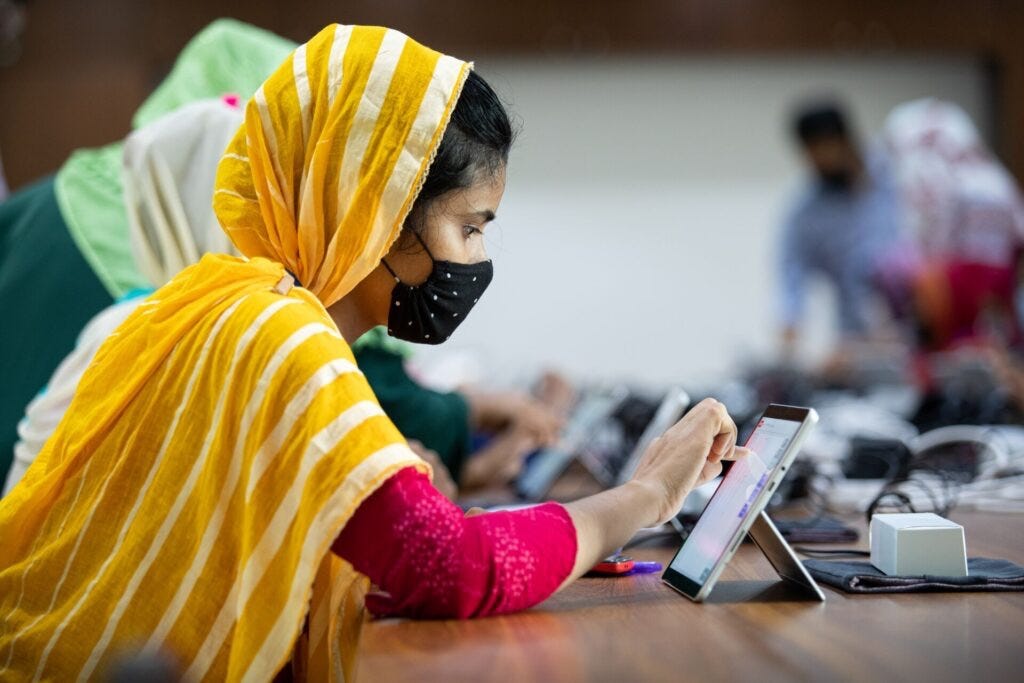
In comparison, Bangladesh’s experience with digital payments is different from Kenya’s, but it reveals an equally important story about how women benefit when financial systems meet them where they are. bKash, the country’s dominant mobile money platform, was built on decades of groundwork laid by NGOs and microfinance institutions—most notably BRAC—which had already brought millions of Bangladeshi women into informal financial networks. That foundation made it far easier for women to adopt digital tools once they arrived. Unlike Kenya, where women primarily received remittances, Bangladeshi women often needed digital finance for wages and entrepreneurship. Millions of women working in the ready-made garment (RMG) sector began receiving salaries directly through bKash, transforming payday from a physically risky, time-consuming ordeal into a private, secure transaction. A BRAC study found that women no longer had to stand in crowded factory lines with cash in hand—lines where harassment, skimming, or delayed payments were common. Instead, bKash allowed them to manage their earnings without interference.
Digital payments also supported Bangladesh’s vast network of female micro-entrepreneurs: home-based workers, tailors, food sellers, and small shop owners who could accept payments, save profits, and build financial histories without needing a formal bank account. But this progress was not driven by bKash alone. Bangladesh had unique conditions—mass internal migration, large inflows of remittances from overseas workers, and a long history of women’s participation in grassroots microfinance—that created real demand for safer, more accessible financial tools. bKash simply amplified these existing dynamics.
The success stories of Kenya and Bangladesh also highlight why digital finance has struggled to take off in countries like Pakistan, Afghanistan, Egypt, and parts of West Africa. In these places, the limiting factor is the absence of the social and economic foundations that allowed women to become crucial adopters. In many low-adoption countries, women are far less present in the labor force, face stricter mobility restrictions, and have significantly lower access to the very tools digital finance requires. According to GSMA, women are 14% less likely globally—and 38% less likely in South Asia—to own a mobile phone than men. Without a phone, the gateway to digital payments is closed. Even when phones are available, women often struggle to obtain the official documents required to open a mobile money account. As the World Economic Forum notes, women in countries such as Bangladesh, Nigeria, Uganda, and Tanzania face legal and social barriers to securing government IDs, and in many economies, discriminatory laws still restrict women’s ability to work at all.
These barriers make it nearly impossible for women to participate in digital finance in the ways Kenyan remittance managers or Bangladeshi garment workers did. Digital payments scaled in Kenya partly because women were already managing household budgets; they scaled in Bangladesh because millions of women were already earning wages in the RMG sector or running micro-enterprises supported by NGO networks. Of course, Bangladesh and Kenya differ in culture, gender norms, and the degree of restrictions women face. However, that contrast is what makes their success so instructive: despite their differences, both countries had social and economic structures where women were already meaningfully involved in household money management or wage-earning. Therefore, digital finance did not create women’s participation—it accelerated it.
When women have limited access to work, mobility, decision-making power, or safe public spaces, digital finance has little room to anchor itself in daily life. If women are not earning income or permitted to manage money, they simply cannot participate in digital payments in any meaningful way. And when half the population is structurally excluded from financial activity, digital finance cannot scale through them—making broader adoption far more difficult.
Ria Basu (GS ‘27) is a junior studying Economics, with a minor in English. She is interested in economic development, politics, and emerging markets.