


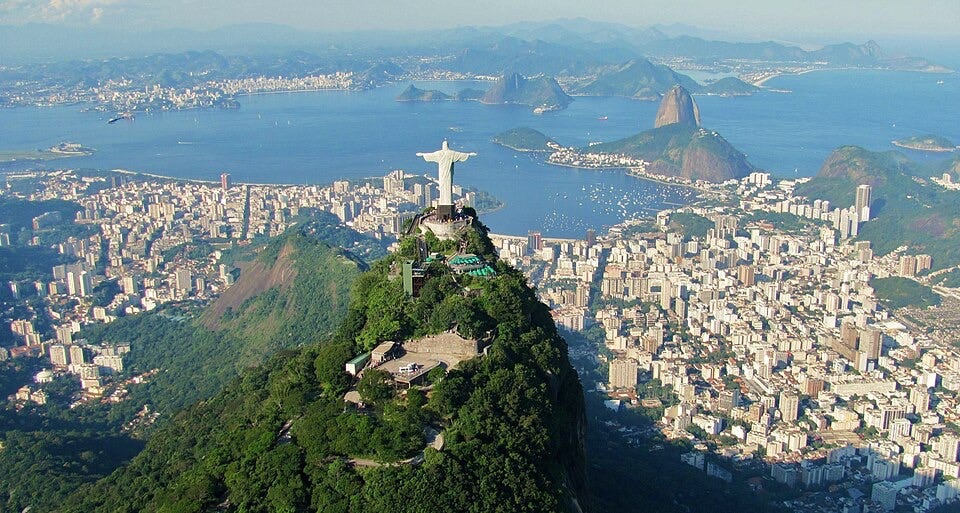
Source: https://commons.wikimedia.org/wiki/File:Cidade_Maravilhosa.jpg

In late 2025, Brazilmania took the Internet by storm: Instagram Reels of travel influencers visiting the country flooded the web. Elected as the 2026 Destination of the Year by Travel and Leisure Magazine, the country is being discovered by foreigners at a scale never seen before. In 2025, the Brazilian Tourism Ministry registered over 9.3 million foreign visitors—a whopping 37.1% increase from the previous year and the largest growth worldwide, according to a 2025 UN tourism report. This is a record-high number, unmatched even during the 2014 World Cup in the country or the 2016 Rio Olympics, leading Brazil to become South America’s most visited destination for the first time ever.
However, the record-high number of tourists and the content’s omnipresence within social media hide a lackluster reality: tourism levels remain relatively modest in comparison to other countries. Similar tropical destinations such as Mexico and Thailand attract an annual 47.8 million and 32.9 million visitors, respectively. Potential exists for Brazil to become the next tourist hotspot, but high air fares, limited English proficiency, and weak international branding have all contributed to Brazil remaining relatively underexplored by global travelers. Through an aviation sector reform, service sector capacitation, infrastructure investments, and continued media exposure, Brazil can develop its recently booming tourist industry and establish itself as a mainstream global destination.
Since 2022, the country’s official tourism agency, Embratur, has been conducting extensive advertising campaigns to attract visitors to the country. Founded in 1966, Embratur plays a key role in promoting tourism by organizing and structuring advertising campaigns, brand positioning, and marketing the country abroad. Embratur operates in tandem with the Tourism Industry, which develops the biannual National Tourism Plan. While results have been positive, its scope is overly concentrated in more traditional, less dynamic media sources such as television and billboards.
Much of Brazil’s tourism boom is due to increased social media exposure. Embratur must adapt to the increasing popularity of social media travel content and start intensifying its social media presence as part of its National Tourism Plan. Creating partnerships with travel influencers visiting the country may strengthen brand recognition. This could be conducted through gaining official financial support or providing free travel experiences and Brazilian goods, emulating a regular business sponsorship on Instagram or TikTok. Additionally, the agency should also invest more in its own social media presence, promoting its own institutional account and its brand account “@visitbrazil.”
By continuing to promote the country overseas, Embratur can play a similar role to Thailand’s Tourism Authority in its own tourism industry development. In the 1990s, Thailand received a similar level of tourists as Brazil currently does. Through active promotion of the country’s brand with campaigns like “Amazing Thailand,” the government transformed tourism into a key economic sector. The campaign involved massive television and billboard advertisement campaigns directed to developed Western markets and China, actively promoting the country’s image as a tourism destination abroad. Today, Thailand is among the top ten most visited countries globally.
Aside from limited social media marketing, Brazil’s air sector is oligopolized and uncompetitive, leading to overly expensive domestic travel prices. Today, the air travel market is concentrated in three main airlines: GOL, LATAM, and Azul, and there are no low-cost alternatives available. This scenario produces ticket prices that prevent tourists from exploring destinations within the country. The average cost of a domestic trip, which can vary extensively depending on distance to destination, is $135 dollars, double that of Peru, the second highest in LATAM, at $70 dollars a ticket.
Underlying this discrepancy is Brazil’s overly bureaucratic judicial system. Brazilian companies are subject to an overarching array of passenger-rights protection acts, most notably the Consumer Defense Code and Brazil’s National Agency of Civil Aviation (ANAC). While offering extensive protection for consumer rights, these well-intentioned measures have flooded the judicial system with endless suits for any minor problems with travel. 90% of all airline-related suits globally are filed in Brazil, despite only containing 2.7% of the world’s flights. On average, one court case or complaint is filed against an airline company every 0.52 flights. By comparison, in America, one court case is filed against an airline every 2,585 flights. This bureaucratic nightmare prevents any low-cost airlines from operating by requiring them to have excessively large and prohibitively expensive judicial departments.
Mexico, once constrained by similar regulatory barriers, offers a useful counterexample. The country’s airline sector, formerly fully served by Aeromexico, was liberalized in the 1990s by the Ley de Aerepuertos, which privatized airports and opened the airspace market to foreign capital. The influx of foreign investment combined with the new airport concession model led to lower prices through greater market competition and increased internal route connectivity through infrastructure expansion. Today, two low-cost airlines dominate the domestic market: Viva and Volaris, offering much more interconnectedness between the country through a democratized, competitive system.
Without significant reforms, Brazil’s airline industry in Brazil will continue to hamper its ability to become a major tourist destination by inhibiting interconnection between the country’s main destinations. To combat this, the government should opt to deregulate the air sector by reforming the regulatory bodies responsible for overseeing aviation. One course of action is to review and condense ANAC’s more than 800 distinct resolutions and norms into a single, centralized code. A clearer compilation of them would provide greater judicial security, allowing more airlines, especially cheap ones, to enter Brazil’s market. More competition would cheapen tickets, improving tourist accessibility nationwide and easing the current overrepresentation in major cities like Rio.
Another alternative measure would be to develop the country’s rail network as an alternative to air travel. Today, there are no major rail networks between Brazilian cities, and road quality is extremely distinct throughout the country, with top-tier expanded highways sharing space with unpaved single-lane roads. Brazil’s geography is also unfavorable for highway travel: the Serra do Mar, a high-altitude terrain close to the coast, forms a significant barrier between beachfront cities and the interior of the country. For example, the trip between Rio and Sao Paulo takes 45 minutes by air but over 6 hours by car under heavy traffic. Plans to build Brazil’s first high-speed rail network between Sao Paulo and Rio, which would reduce travel time to under two hours, are set to begin construction in 2028. Fostering the development of rail links can offer more varied and sustainable ways for traveling between the country’s major destinations.
The lack of English proficiency also represents an important constraint for international tourism, with estimates showing that only between 1-5% of the country’s population has some sort of English proficiency. Brazil’s already existing National Service of Commercial Apprenticeship (SENAC) provides a way for workers to improve their language skills for future work in the tourism industry. SENAC, established in 1945, is a government-sponsored independent institution that provides service-sector workers a wide range of subsidized—and often free—skill courses. By expanding its English language courses and creating a dedicated department for the tourism sector, the agency can support the nationwide growth of the country’s tourism sector by training and certifying professionals all over the country.
Brazil has a critical opportunity to fully leverage its unique culture and diverse landscapes to become a top tourist destination worldwide. By implementing measures such as solidifying its social media presence, deregulating and simplifying airline rules to lower costs, and subsidizing trade school courses for the tourism sector, the country can develop long-term requisites for mass tourism and cement competitive advantages over other similar destinations. In doing so, Brazilmania will not fade as a mere social media trend but become a lasting ethos, promoting economic development and cultural influence commensurate with its vibrant identity and unique geography.

Hugo Bueno (CC ‘29) is a rising sophomore from Rio de Janeiro, Brazil. Passionate about politics, economics, and inclusive education, he seeks to pursue a major in Financial Economics with a minor in Political Science. Hugo hopes to later work in Asset Management or Equity research. In his free time, he enjoys reading, writing, and trying new foods!