



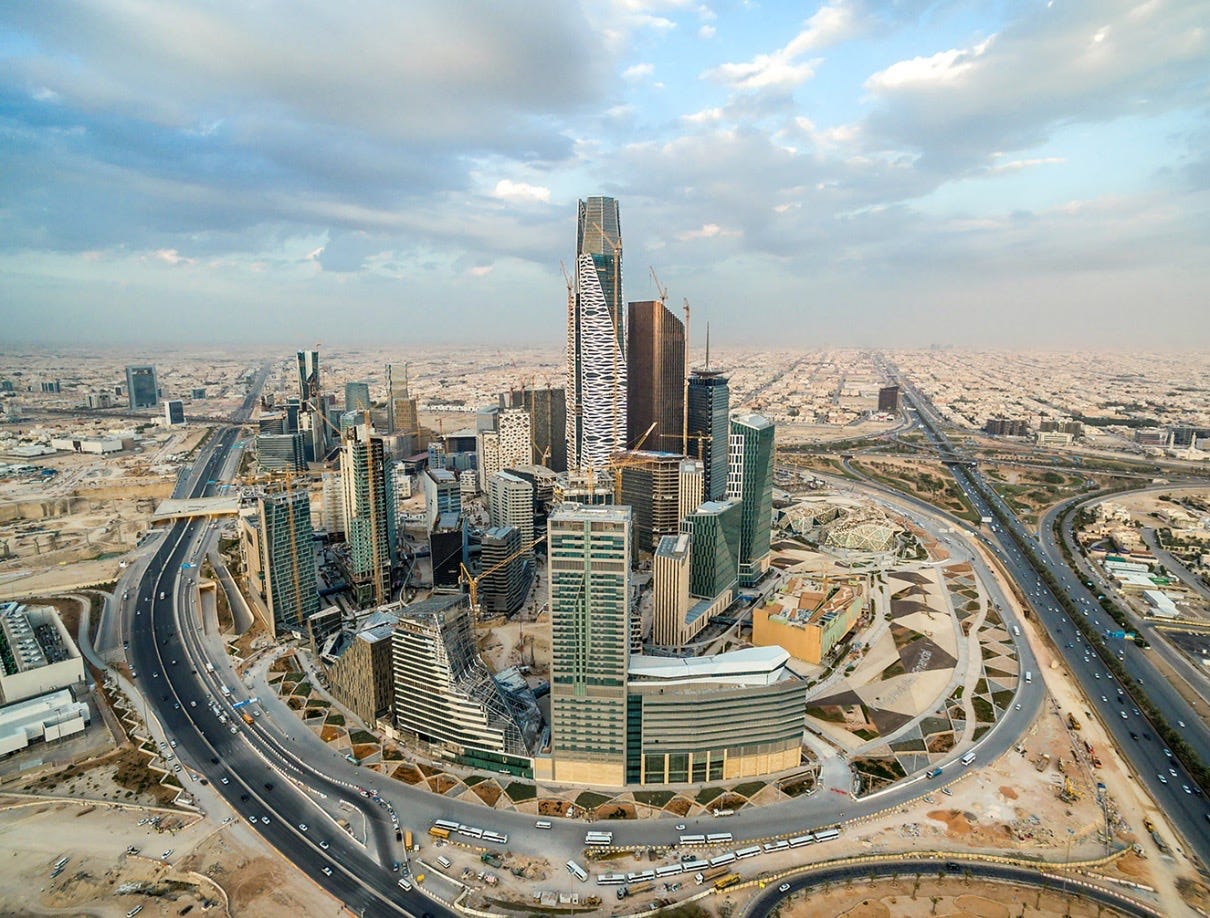
“The Kingdom is open for business,” reads Saudi Arabia’s Vision 2030. Simple, confident, and deliberate.
Over the past decade, Saudi Arabia has steadily rewritten its investment rulebook to draw global capital, culminating in a September announcement that the long-standing 49 percent cap on foreign ownership in listed companies may be lifted by year-end. On paper, this looks like a major liberalization moment—a signal that the world’s largest oil exporter is ready to let global investors take real stakes in its economy. In 2016, Mohammed bin Salman framed that ambition in grand terms, proclaiming that Saudi Arabia will become “an investment power on a global scale” and has been promising $6 trillion in investment opportunities over the next decade.
In most emerging markets, such announcements have signaled not just openness to capital, but openness to outside influence. When India liberalized in the 1990s, foreign investors reshaped automobiles, telecom, and consumer goods. When China brought in foreign manufacturers in the 1980s, it triggered decades of externally driven industrial transformation. Across Eastern Europe, the post-communist privatization waves saw foreign firms take majority stakes in banks, telecom companies, and energy networks, transforming how entire sectors were run.
Saudi Arabia is trying to achieve something different. Rooted in the logic of Vision 2030, the state knows an oil-dependent economy cannot sustain long-term growth and aims to build a more diversified and resilient base. To do that, it has identified a set of priority sectors it wants to accelerate: tourism and entertainment, logistics and transportation, renewable energy and hydrogen, advanced manufacturing, biotechnology and health, and financial and digital services. These industries require outside capital and expertise, yet the government is unwilling to give up strategic control of their development.
As a result, Saudi market access remains nationally steered. The Kingdom is opening its markets within what might be called a sandbox economy—a system that allows foreign money in, but only inside boundaries set by the state. This model gives investors predictability about where the state is steering the economy, but it also limits the bottom-up experimentation and competitive pressure that drive innovation in more open markets.
Symbolism and Substance
Lifting the 49 percent cap may signal openness, but it does not mean foreigners can buy Saudi companies outright. Under today’s rules from the Capital Market Authority (CMA), a single foreign investor can hold at most 10 percent of a listed company’s shares, and all foreign investors together are normally limited to 49 percent of the company. Policymakers have discussed removing this 49 percent ceiling and ending the old “Qualified Foreign Investor” program so that foreigners can trade directly on the Tadawul, Saudi Arabia’s stock exchange. Even if the overall cap is raised, the 10 percent per-investor limit and other safeguards (e.g. pre-approval requirements, disclosure thresholds, limits on board representation) would still allow the state to shape who can build a large stake.
These steps serve a clear purpose. Loosening ownership restrictions increases the pool of potential buyers, which raises trading activity and improves liquidity. It also allows Saudi stocks to qualify for a larger weight in global indices such as MSCI and FTSE Russell, encouraging index-tracking funds to buy more shares. Together, these effects help Riyadh deepen its domestic capital markets; however, they do not hand decision-making power to outsiders.
Foreign Strategic Investors: Influence, But on the State’s Terms
Despite the 10 percent single-entity ownership limit, foreign investors are not without channels for deeper participation. The clearest is the Foreign Strategic Investor (FSI) framework. Introduced in 2019, the framework reflects the reality that many of Saudi Arabia’s biggest listed companies are still tied to the state, whether through government stakes, the Public Investment Fund (PIF), or long-established family groups. Under the FSI rules, select foreign investors may exceed standard ownership caps, but only under tightly controlled conditions. Investors have to commit to long-term shareholding, demonstrate a clear role in improving operational or financial performance, and align their involvement with national economic goals as outlined in Vision 2030. These rules channel foreign investors to contribute technical knowledge and stability while the state retains strategic control.
Notably, the FSI framework didn’t open a new door so much as codify an already existing practice. A clear example is Allianz Saudi Fransi, a Saudi insurance company founded in 2007 as a joint venture between German insurer Allianz and the domestic Banque Saudi Fransi. Allianz held a 51 percent stake—a rare arrangement under today’s ownership caps—and entered the market as Saudi Arabia was overhauling its cooperative insurance framework and encouraging international expertise. The joint venture saw Allianz bring in new insurance products, updated underwriting practices, and improved risk-management systems. In 2024, it sold its majority stake to Abu Dhabi National Insurance Company (ADNIC), another state-supervised regional firm.
Petro Rabigh, a Saudi petrochemical company, followed the same logic. Created in 2005 as a joint venture between Saudi Aramco and Japan’s Sumitomo Chemical, an industrial leader in petrochemicals, Sumitomo initially held a 37.5 percent stake in Petro Rabigh. Aramco sought a partner with advanced chemical-processing technology and global marketing reach as it moved downstream into higher-value production. As the project matured and Saudi capabilities deepened, Aramco gradually repurchased Sumitomo’s shares, reducing the Japanese firm’s ownership to roughly 15 percent. This followed the same pattern as Allianz: foreign partners are invited to provide expertise and scale, then gradually step back as Saudi and regional owners buy back shares. The gradual return to domestic control reflects a deliberate feature of the Kingdom’s economic management.
Greenfield vs Brownfield: Partnership as Permission
These cases show how foreign investors can take meaningful stakes in Saudi firms, but only within structures the state designs and supervises. A similar logic operates at the project level. Foreign investors have held large equity positions in Saudi companies, but almost exclusively when they helped found new ventures in collaboration with domestic institutions. This is the greenfield model, where projects are built from scratch with purpose-built ownership structures. Brownfield acquisition, meaning the purchase of an existing company, introduces outside ownership into firms that were not built with such arrangements in mind, and therefore, still remains tightly constrained.
This pattern shapes how different foreign partners approach Saudi Arabia. Chinese companies, in particular, have become major participants in greenfield ventures across clean energy, digital infrastructure and manufacturing/logistics. Greenfield ownership provides them with large equity positions, while the state retains strategic control.
At the center of this model stands the PIF, Vision 2030’s financial engine. The PIF anchors or co-develops most major greenfield initiatives, from industrial ventures to infrastructure and energy projects, and it manages the broader public-private partnership pipeline that channels foreign participation into state-defined priorities. Its influence stretches well beyond the projects it directly owns. Even ventures that appear private tend to operate within the investment architecture the PIF has drawn, following sectoral strategies and governance frameworks shaped by the fund. For nearly all foreign firms, collaboration with the PIF is requisite.
Where the Model Meets Reality
In a sandbox system, where the state directs both ownership structures and investment channels, Saudi Arabia’s economic trajectory ultimately turns on how effectively it can deliver command-and-control innovation at scale. Saudi Arabia has faced this challenge before. The mid-2000s Economic Cities program relied on the same top-down logic that underpins today’s sandbox. Despite large budgets and ambitious targets, these projects struggled to attract residents or private-sector activity, and many fell short of their employment and investment goals. They revealed how hard it is for state-designed zones to turn big visions into commercially viable outcomes. The Vision 2030 giga-projects are a larger version of this model. They aim to anchor new sectors, but several have already faced timeline revisions, scaled-back targets, and rising costs. In 2024, even the PIF reported impairments tied to delays and higher development expenses, indicating familiar execution pressures at a larger scale.
This pattern reflects ambition outpacing execution. Saudi Arabia can marshal vast capital, mobilize its bureaucracy, and move quickly at the outset of a project. The challenge emerges later: translating large visions into commercially viable, fully functioning cities and industries. Inside the sandbox, these execution challenges carry broader implications. Investors cannot diversify risk through alternative avenues because the state is the central architect of the entire system. For foreign firms, the opportunities are real, but so is the exposure: investment performance depends less on market forces than on the state’s capacity to turn plans into functioning industries. The Kingdom may be open for business, but the results of that opening will be measured by what the state can actually build.
Atulya Madhavan is a junior in Columbia University’s School of General Studies, where he majors in Data Science. He contributes to the Columbia Emerging Markets Review and works with Columbia Global Research Consulting as a project lead on real-estate analytics and low-carbon investment research. His work focuses on emerging markets, financial systems, and the intersection of policy, technology, and economic development.