



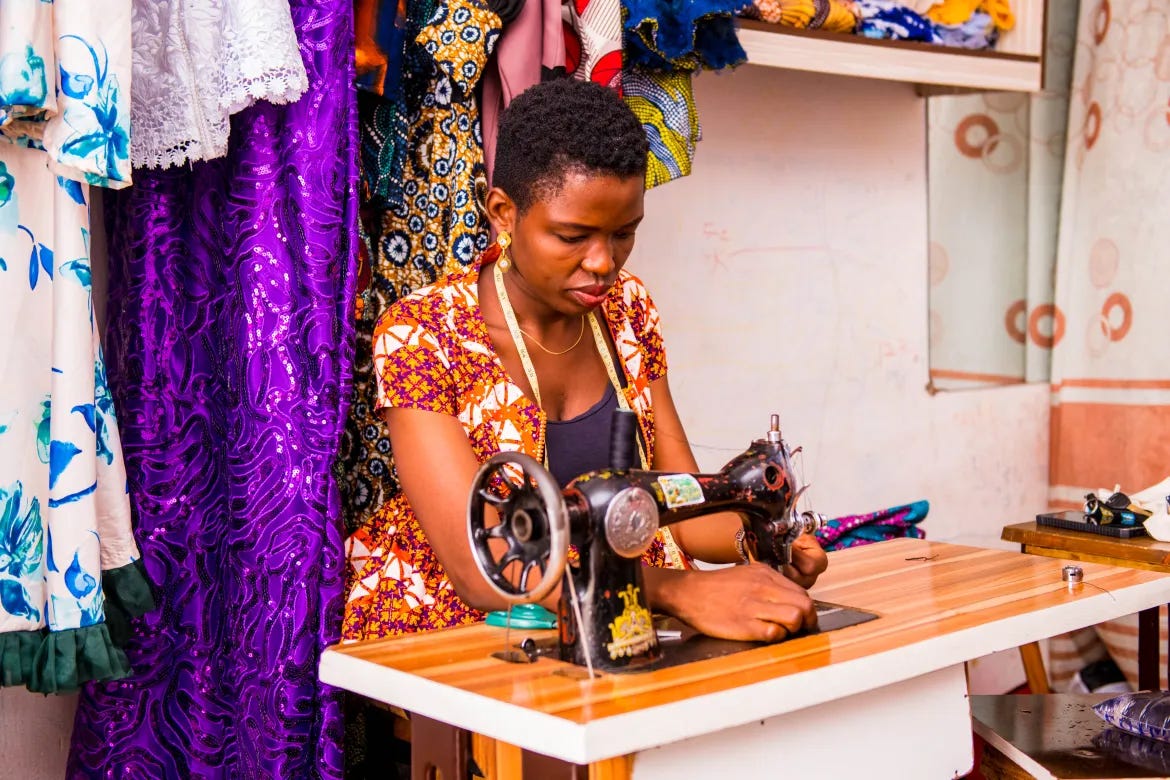
In Nigeria, women entrepreneurs have the potential to play a key role in helping to shape economic stability and growth. Women-led small and medium enterprises (SMEs) contribute significantly to GDP growth and community development, particularly through critical investments in healthcare, education, agriculture, and consumer services. Unlike extractive industries, which concentrate wealth and are highly cyclical, these businesses operate with more efficient capital allocation and reinvest profits locally, facilitating more inclusive and stable growth. These businesses operate with efficient capital allocation and reinvest their profits back into household and community wellbeing. Furthermore, these sectors form the backbone of Nigeria’s non-extractive economy and reduce the dependence on volatile commodity exports like oil. For this reason, Nigerian women-led SMEs have the potential to be a powerful stabilizing force in this emerging market. These enterprises should receive greater institutional investment from global investors and policy support from governments, not only for inclusion, but because women-led SMEs are a critical stabilizing force in the economy.
Nigeria has one of the highest levels of female entrepreneurial activity in the world. According to this report Mastercard Index of Women Entrepreneurs, 83% of Nigerian women consider themselves entrepreneurs, significantly higher than the regional average of 51% across Eastern Europe, the Middle East, and Africa. Their entrepreneurial spirit has allowed women to own around 41% of micro-businesses in Nigeria and approximately 23% of small and medium enterprises according to this report from the Global Voices Organization.
SMEs maintain the foundation of Nigeria’s economy. In the International Journal of Small Business and Entrepreneurship Research, Deborah Oluwadunmininu Oluremi states that Micro, small, and medium enterprises account for 96% of businesses, contribute 50% of the country’s GDP and offer a critical share of employment in the nation. As a result, the expansion of Nigerian female-owned enterprises allows for job creation, income generation, and economic diversification. Because women typically dominate sectors like fast-moving consumer goods (FMCG) and agro-processing, they bridge the gap between production and local consumption. This alleviates the shocks of the Nigerian resource-dependent economy. When oil prices plummet, local SMEs serve as a buffer, maintaining the flow of essential services and ensuring domestic liquidity.
According to Reuters, in Nigeria, oil accounts for 90% of export earnings but contributes only 4% economic growth. In contrast, SMEs account for 50% of Nigeria’s GDP, diversify and rebalance the economy, maintain the supply chain and contribute other positive externalities for the community. This role becomes critical in economic downturns, as Nigeria’s women-led SMEs that are focused in sectors such as sectors such as food distribution, healthcare, and education, exhibit counter-cyclical properties. Extractive industries, like oil, are inherently pro-cyclical, expanding during commodity booms and contracting during price declines, which can be devastating for a resource dependent economy. However, these statistics from the World Bank show that during the 2014 and 2020 oil shocks, women-led SMEs helped to sustain domestic liquidity and prevent a collapse in access to essential goods and services. In this case, they were a significant force in economic recovery. Thus, woman-led SMEs can help to reshape the Nigerian economy by redirecting growth from overreliance on oil and toward broader domestic production and consumption.
In many cases, women-led businesses enhance their contribution to the community because they operate in sectors that generate strong positive externalities, specifically in health services, education, and agriculture. For example, women-owned agricultural enterprises often reinvest earnings into improving food security at the household level, while female-led education businesses expand access to schooling in underserved communities. Similarly, female entrepreneurs in healthcare frequently establish local clinics or pharmacies, increasing access to essential services where public infrastructure is limited. In Nigeria, where public infrastructure and social services are under strain, this cycle of reinvestment led by female entrepreneurs creates a positive multiplier effect that strengthens communities and long-term human capital growth. These businesses help to distribute income more equitably, create employment opportunities, and encourage consumption in communities.
Still, despite their economic significance, women entrepreneurs in Nigeria face major structural and systemic barriers. Access to financing is one of their most persistent challenges for Nigerian women. While women own a significant share of micro and small businesses, most are forced to operate within an informal economy and struggle to obtain credit or formal investment. A United Nations report estimates that only about 23% of women-owned businesses in Nigeria have access to credit, which restricts their ability to scale and invest in long-term growth. This gap is particularly damaging in Nigeria’s resource-dependent economy. Capital is disproportionately allocated to extractive industries instead of diversified sectors that could generate broader employment and stability. This financing gap severely constrains the impact and potential of Nigeria’s entrepreneurial energy, one of their most significant untapped resources and critical hedge in ensuring economic stability and resilience.
Countries that prioritize women’s economic empowerment experience significant increases in productivity, growth, and human capital development. For example, the Doi Moi reforms in Vietnam refocused the economy on labor-intensive exports and SME growth, strategically integrating women into the workforce. Furthermore, these reforms created institutional frameworks that allowed SMEs, especially women-led ones, to access formal credit and facilitated their integration into export markets. Currently, according to the International Monetary Fund, Vietnam’s female labor-force participation rate stands at approximately 70%, which is one of the highest rates globally. This participation has allowed Vietnam to achieve and maintain a GDP growth rate of 7% and reduced the Vietnamese economy’s vulnerability to agricultural price shocks. While the Nigerian economy differs greatly, Nigeria could emulate Vietnam’s example and expand opportunities and women’s access to capital in order to receive the same economic growth and diversification as well.
Expanding access to credit, venture capital, and other investments could allow Nigerian women-owned businesses to scale more effectively and enhance their contribution to national economic growth and community development. Government sponsored programs such as targeted lending initiatives, mentorship networks, and entrepreneurship training could empower female founders as they expand their businesses and enable them to break into higher-growth sectors. Specifically, many women-led SMEs operate in the margin, needing financing between $10,000 and $100,000, which is too large for microfinance but too small for venture capital. Addressing this financing gap would significantly increase productivity, and allow these enterprises to scale substantially.
Usually, gender-based economic initiatives are framed as social or philanthropic programs. However, the growth of female entrepreneurship in Nigeria proves that empowering women-led businesses is not just to promote equity but also to facilitate economic growth and stability and community benefit. Nigerian women entrepreneurs are able to contribute to economic resilience and growth in ways that traditional economic models and strategies often overlook. Investing in Nigerian female entrepreneurship is one of the most effective strategies available to maintain sustainable economic growth within the country. With greater institutional support, Nigerian female entrepreneurs can become a powerful force for stability and growth across the African continent.

Amani Dhillon is a sophomore at Columbia College studying Financial Economics and Computer Science. Her academic interests include the intersection of technology and finance, analyzing macroeconomic trends and identifying the potential of emerging companies within emerging markets.