


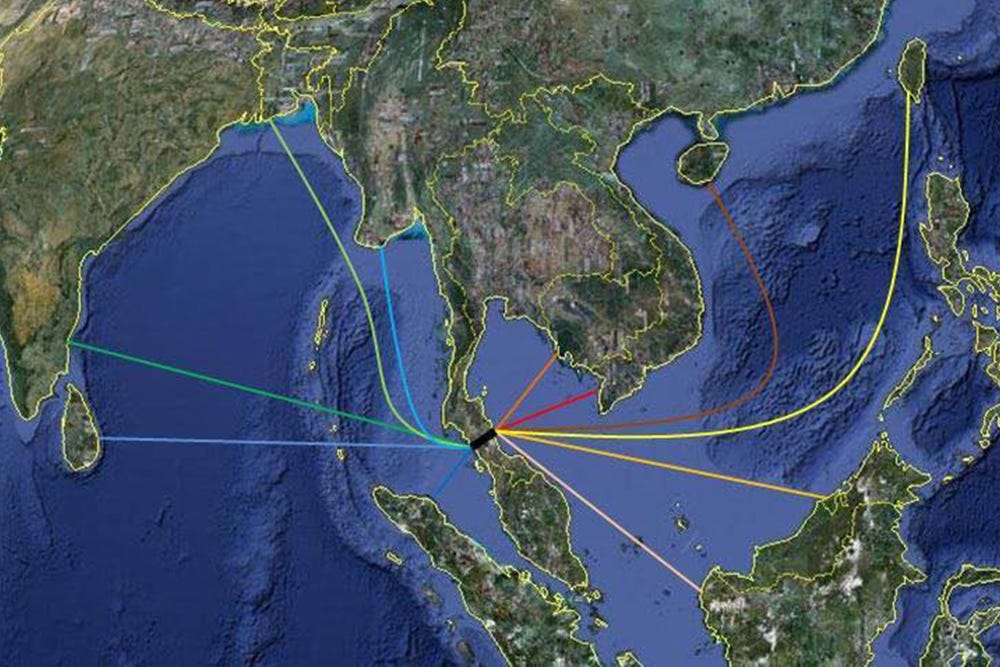
Once hailed as an “economic tiger,” Thailand now finds itself burdened with a far less flattering label: the “sick man of Asia.” The nation now finds itself grappling with severe economic paralysis across its three primary pillars: consumption, manufacturing, and tourism. However, there exists a proposal that could alter this trajectory and reestablish Thailand as a regional economic powerhouse: the Kra Canal. When the Suez Canal was built, it immensely transformed Europe’s trade routes, marking Egypt as one of the world’s most important maritime chokepoints. The Kra Canal holds potential to do the same for Thailand. The canal would significantly rewire Asia’s trade routes as it would allow ships to bypass the Malacca Strait, marking Thailand as a central maritime hub. The traffic that this canal would attract would unlock substantial economic gains for Thailand through transit revenues, the birth of adjacent industries, increased foreign investment, and a strengthened position at the center of global trade.
This project would deepen Thailand’s economic and strategic ties with China, while also risking heightened tensions with the United States, as it would advance Beijing’s interests by providing an alternative to the Strait of Malacca, thereby enhancing the security and efficiency of its trade and energy routes. Although the Kra Canal will strain Thailand’s historical geopolitical neutrality in terms of US-China relations, the project’s potential to attract sustained Chinese capital makes siding with Beijing the most economically advantageous and politically strategic path for Thailand’s long-term ascent as a regional power.
Background Information on the Canal
The Kra Canal project has been a topic of discussion for centuries as the promise of an alternative route to the Malacca Strait, the busiest waterway in the world, would entirely rewire Asia’s trade routes. While the project has never come to fruition due to geopolitical risks and cost factors, its potential impact keeps it in strategic conversations. The project proposes the construction of a channel along Southern Thailand’s Isthmus of Kra to connect the Gulf of Thailand to the Andaman Sea. This would allow ships to bypass the Strait of Malacca, cutting voyages by roughly 1,200 nautical miles, reducing fuel costs, and easing congestion. Currently, over 70% of China’s petroleum and liquified natural gas imports are transported through the Malacca Strait, making it the most important sealine for the Chinese economy. Furthermore, the strait is a strategic vulnerability for the nation, as it is controlled by a US-dominated alliance: Singapore and Malaysia. Therefore, in recent years, China has become increasingly interested in reviving the Kra Canal project as part of its Maritime Silk Road initiative — a component of the Belt and Road Initiative (BRI) — to enhance its energy security. China has voiced its willingness to supply financial and technological support to Thailand in hopes that the canal reaches fruition.
Benefit for Thailand
As a country that has been trapped at a meagre 2% growth rate for the past five years, Thailand is in need of a revitalization project unless it wants to fall behind its Southeast Asian competitors. The Kra Canal would generate a steady flow of foreign currency into Thailand through transit fees and related economic activities. It would also create opportunities for fuel services, including the sale of Thai oil to passing vessels. By allowing all Thai oil tankers – both inbound and outbound – to bypass the Strait of Malacca, the canal would significantly reduce transportation costs, which in turn would lower domestic production costs and ultimately decrease prices within the country. From a national security perspective, the canal would enhance the Royal Thai Navy’s ability to discreetly move personnel and vessels between the Andaman Sea and the Gulf of Thailand, minimizing suspicion from neighboring states. This increased naval mobility would strengthen the nation’s military exercises, patrol operations, and surveillance efforts, bolstering Thailand’s ability to defend its territorial waters.
Cost and Reward Factor
One of the main criticisms of the Kra Canal is that its costs may outweigh its potential benefits, given not only the high construction costs but also the geopolitical risks of straining relations with the United States and regional partners. Yet, as of 2025, Thailand has opted for a $28 billion land bridge project–an overland transport corridor designed to facilitate cargo movement between the Gulf of Thailand and the Andaman Sea–instead of the canal that would have cost approximately $30 billion. This alternative aims to achieve the same economic benefits as the canal without the geopolitical risks. This raises a critical question: if Thailand is already willing to invest nearly $30 billion, why not allocate comparable resources toward a canal that promises far greater long-term returns?
A canal would generate substantially more long-term return for Thailand than a bridge as it would capture value from global shipping traffic, while a bridge would mainly collect tolls from land traffic, which is far smaller in scale. In a canal, ships pay transit fees ranging from hundreds of thousands to over a million dollars depending on cargo size. On the other hand, a bridge only collects tolls from trucks and cars, which are much cheaper per crossing. Furthermore, a canal would produce secondary industries such as oil storage terminals, ship repair, and restaurants or leisure activities for workers around the area. In addition, cities could emerge around the canal similar to Port Said at the Suez Canal or Colón at the Panama Canal. A bridge would generate far more limited spillover economic activity in comparison as it would have a more limited impact on trade routes and draw less traffic.
Furthermore, logistically, a canal would be far more efficient. A land bridge would require ships to dock, unload cargo, transport it across land, and reload. The process is an expensive, labor-intensive process that could take days. On the other hand, a canal would allow ships to pass directly between the Andaman Sea and the Gulf of Thailand without interruption, making the process far more efficient. From a logistics standpoint, a canal is far more attractive to global shipping companies who prioritize continuity, minimal handling, and reduced risk.
However, a significant danger of the canal would be its potential to exacerbate southern Thailand’s separatist movement: a long-running, violent insurgency that has persisted since 2004. The movement has been primarily driven by segments of the local Malay-Muslim population who seek greater autonomy or full independence from the Thai state due to grievances over cultural marginalisation, political representation, and economic inequality. The conflict has involved guerrilla attacks, bombings, and targeted killings, and has resulted in over 7,000 deaths over the past two decades. By physically dividing mainland Thailand from its southern provinces, the Kra Canal would heighten perceptions of separation and marginalisation. As a consequence, this could strengthen the insurgency’s narrative of exclusion, making territorial integration more difficult and reinforcing separatist sentiment.
While concerns about internal fragmentation are often raised, such risks must be weighed against the broader opportunity for Thailand to assert itself as a regional power and reshape its strategic position within global maritime trade networks. Instead of being too afraid to reckon with their neighbors, it is about time Thailand steps up as a leading force in Southeast Asia. With the canal, Thailand could have strategic control of trade routes and gain geopolitical leverage similar to countries controlling major maritime choke points: Egypt with the Suez Canal and Panama with the Panama Canal.
Geopolitical Consequences of the Kra Canal
For China, the Kra Canal would address its “Malacca dilemma“ : the vulnerability of its maritime trade routes to potential blockades by rival naval forces, particularly the United States. A hypothetical China-controlled canal would enhance Beijing’s control over its supply chain and maritime security, while boosting its geopolitical influence in the region. Notably, the canal would enable China to establish a stronger presence in the Indian Ocean, allowing the PLA Navy greater operational flexibility and enhancing its ability to protect critical sea lanes.
Given these benefits to China, US hostility would stem from opposition to Thailand directly accelerating the future of their trade rival. However, it is important to note that the United States has never issued any formal policy position specifically condemning the Kra Canal project, nor has it taken an active role in shaping its development. Instead, American engagement has largely been limited to strategic analysis within policy and academic circles as the project has remained largely hypothetical. This limited direct engagement, however, should not be interpreted as indifference. US foreign policy in the Indo-Pacific has been broadly structured around containing Chinese influence. Central to this strategy is the preservation of influence over the Strait of Malacca, where the United States relies heavily on its alliance with Singapore and Malaysia, to sustain maritime access and security cooperation. The Kra Canal would represent a structural disruption to the existing maritime order by offering an alternative passage that bypasses a US-aligned corridor, thereby weakening Washington’s indirect leverage over one of the world’s most critical trade arteries.
Singapore, a nation whose entire existence rests on controlling and processing maritime flows, would suffer a significant economic blow as traffic deviates away to the Kra Canal. This project would reduce Singapore’s significance as a central shipping hub, diminishing its leverage in global politics. On the other hand, the canal would alarm India as it would give China direct access to the Bay of Bengal, strengthening China’s maritime footprint near their sphere of influence.
The canal would also have significant implications on relations within ASEAN as it would reshape regional trade routes, alter economic hierarchies, and introduce new tensions between its member states. The increase in Thailand’s strategic importance would shift the balance of power within the trading bloc as Thailand gains more leverage over decision-making. This shift could therefore generate economic rivalry and diplomatic friction within ASEAN. However, the canal could also encourage regional cooperation as other countries may also aim to capitalize on the gains of the canal; ASEAN countries might invest in connected ports or railways to integrate the canal into broader regional supply chains.
The Strategic Case for Aligning with China
Often called the “Switzerland of the East”, Thailand has long had a history of political neutrality. However, in an era of intensifying US-China rivalry, such strategic ambiguity risks becoming a liability rather than an asset. In recent years, Thailand has already begun tilting toward China through deepening economic ties and expanding military cooperation. Since 2012, China has become Thailand’s largest trading partner, with Chinese capital flowing into key sectors such as manufacturing, infrastructure, and tourism. This shift is particularly notable given Thailand’s historical alliance with the United States, one of Washington’s oldest in Asia, dating back over seven decades. Yet that relationship has shown signs of strain, especially following Thailand’s 2014 military coup, after which the U.S. suspended military aid and distanced itself from the new government. In the years since, Thailand has moved closer to China, reflecting both pragmatic economic considerations and shifting geopolitical realities. Some analysts argue that this realignment anticipates a broader transition in global power. The United States is perceived as entering a period of relative decline – marked by overextension in international conflicts and mounting economic pressures – while China has positioned itself more cautiously and strategically on the global stage. From this perspective, aligning more closely with China could allow Thailand to better position itself within an emerging international order increasingly shaped by Beijing’s economic and geopolitical influence.
Conclusion
Ultimately, the Kra Canal would be a redefining strategic choice about Thailand’s future position in the global order. While the risks ranging from domestic instability in the south to heightened geopolitical tensions with the United States and regional partners are real and cannot be dismissed, they must be weighed against the scale of transformation the canal could unlock. At a time when Thailand’s economic growth has stagnated and regional competitors are accelerating ahead, incremental solutions such as the land bridge may preserve neutrality but would not deliver the same magnitude of long-term gains. The canal, by contrast, offers Thailand the opportunity to reposition itself as a central hub in global trade. In doing so, it would inevitably deepen Thailand’s alignment with China. Rather than clinging to a model of neutrality that may no longer be sustainable in an increasingly polarized world, Thailand must consider whether strategic alignment, if carefully managed, can serve as a vehicle for national advancement. The Kra Canal, therefore, is not simply a question of cost or feasibility, but of ambition: whether Thailand is willing to accept short-term geopolitical trade-offs in pursuit of long-term economic and strategic ascendancy.

Prim Atikarnbodee is a student at Barnard College, majoring in Economics and Political Science. Her main areas of interest lie in political economy, with a focus on emerging market development, international relations, Global South politics, and energy security. She is passionate about examining how global trade and capital flows shape growth, inequality, and development outcomes, specifically in Southeast Asia, the Middle East, and North Africa.