



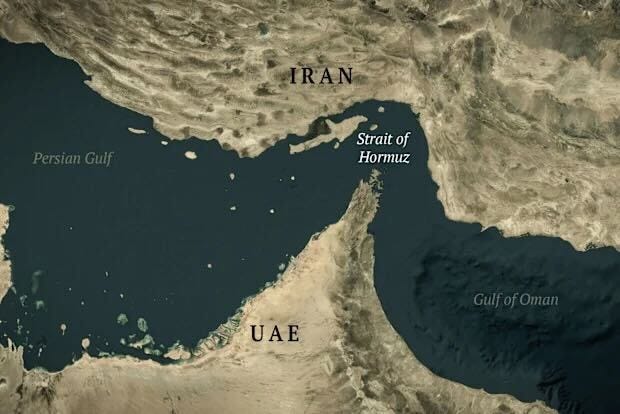
As countries begin to transition away from fossil fuel investments, their choices are often justified as commitments to climate. But for nations built on oil production, like the UAE, economic decisions are not as straightforward; instead, they are shaped by infrastructure like the Strait of Hormuz, a critical oil chokepoint that passes through the Persian Gulf. In short, the threat of a Strait of Hormuz closure has fueled the UAE’s economic agenda through efforts to bypass the channel, and has compelled them to increase renewable energy and technology investments.
About one-fifth of the world’s crude oil passes through the Strait of Hormuz, making up nearly 70% of the UAE’s total exports and positioning the country as one with a commodity-reliant economy that is vulnerable to shocks in the strait. These high stakes have been repeatedly raised by geopolitical tensions, from US sanctions on Iranian oil exports to larger scenarios like the current US-Israel-Iran conflict that has resulted in an ongoing strait closure. Given the vulnerability of such a critical pipeline for the UAE’s economy, reducing the country’s dependence on the strait is paramount, and seems to be already indirectly taking place.
One of the earliest threats to the Strait of Hormuz occurred at the beginning of 2011 and continued into 2012; this was Iran’s response to Western sanctions resulting from suspected nuclear proliferation. Not coincidentally, the UAE began its most direct response to strait dependence in July of 2012: the Abu Dhabi Crude Oil Pipeline Project (ADCOP). ADCOP, or the Habshan-Fujairah Pipeline, connects southwest Abu Dhabi to the Gulf of Oman, allowing exports to bypass tensions in the Strait of Hormuz. When this project was initially announced, the UAE Embassy released a statement regarding the channel’s projected capacity, writing that the motivation behind the channel is to maintain energy stability. The mention of energy stability is an indirect reference to possible conflict in the strait, and a clear motivation to bypass it. The UAE believes that reduced dependence on the strait is necessary, and this response to create their own oil channel can be seen as a strait-induced initiative.
The UAE’s more recent investment decisions demonstrate a shift away from oil dependence entirely. Most notably is the UAE’s investment in green hydrogen, a mechanism used to store and export renewable energy. The UAE is one of two Gulf countries investing in this new idea, but it stands out for the extent of its investment. The UAE’s National Hydrogen Strategy 2050 outlines their plan to become a large global producer and exporter of hydrogen, eventually transitioning to a hydrogen economy. Green hydrogen is also being directly cited as Asia’s strategy to reduce dependence on the Strait of Hormuz, demonstrating the culminating effects of the UAE’s investment. The country’s ambitions to export hydrogen signals their efforts to replace oil exports with hydrogen and other green energy sources in the long-term, and rule out oil channel vulnerability entirely. This large transition highlights the UAE’s understanding of the weaknesses that an oil-dependent economy can have when channels critical to transport oil have become points of conflict.
Aside from redirecting oil flow and transitions toward a green economy, the UAE has also made investments offshore, such as the most recent merger between the Abu Dhabi National Oil Company (ADNOC) and the Canadian-based company NOVA Chemicals Corporation. NOVA is a polyethylene producer, turning crude oil into synthetic products like plastic or rubber. This deal was facilitated by the Mubadala Investment Company, a $330 million portfolio owned by the government of Abu Dhabi. In response to the recent strait closure, ADNOC’s CEO Dr. Sultan Ahmed Al Jaber spoke about the merger at CERAWeek, an energy conference. He stated that strait vulnerability is the reason why ADNOC has sought out partners in other regions, like the United States. This strategic deal represents the UAE’s desire to invest in more stable markets, and explicitly cites the strait as the cause for this. And, this isn’t the only global investment the Mubadala Investment Company has made, with their most recent financial statement listing profits from Jio Platforms, Princeton Digital Group, Tata Power Renewable Energy, and Aligned Energy, none of which are Gulf-based companies.
On the other hand, it is arguable that the threat of a strait closure is not the driver behind the UAE’s economic policies, and that volatility in oil prices, among other factors, could play a larger role. Earlier this year, oil prices surged from around $60 to $144 per barrel, and in 2014, following the US shale production boom, crude oil prices fell from $105 to $30 per barrel. The UAE’s response to this has been split into two categories: economic diversification away from oil and fiscal initiatives such as increasing domestic energy prices and removing transportation subsidies. The UAE launched the National Vision 2021 in 2014, with the goal of creating a knowledge economy. However, with ADCOP construction beginning before this drop in oil prices and the release of the National Vision, it’s clear that the UAE has had intentions of bypassing the strait specifically, especially considering that the Habshan-Fujairah pipeline is still susceptible to volatile oil prices. Likewise, the ADNOC and NOVA merger presents a threat in the form of oil price volatility, and with this initiative being so recent, it seems that the UAE is not avoiding oil investments. Mubadala’s most recent investments covering non-oil sectors like technology may seem like a response to potential oil price shocks. However, with their portfolio companies being based in other regions like the US or India, this move represents a broader shift away from Gulf investments entirely, more closely aligning with a goal to steer clear of strait vulnerability.
The Strait of Hormuz’s position as a geopolitical flashpoint has provided a basis for the UAE’s many economic policies and proposals for reform. Initiatives like ADCOP and investments in green hydrogen position the UAE for long-term growth, and represent how vulnerability in the most critical oil export channel is altering the UAE’s economic approach. Most likely, neighboring countries are finding themselves with similar economic decisions given the ongoing strait closure. This shift in the region’s economic agenda is therefore better understood as unique to the geopolitical conditions it is situated in.

Mihika is a freshman at Barnard College, studying Economics and Mathematics. Through conducting policy-oriented research in debate, she has developed a curiosity for how rapidly developing economies respond to market and political fluctuations. Not only does she enjoy writing for CEMR, but she also finds joy in cooking and feasting on food from the regions she researches.