



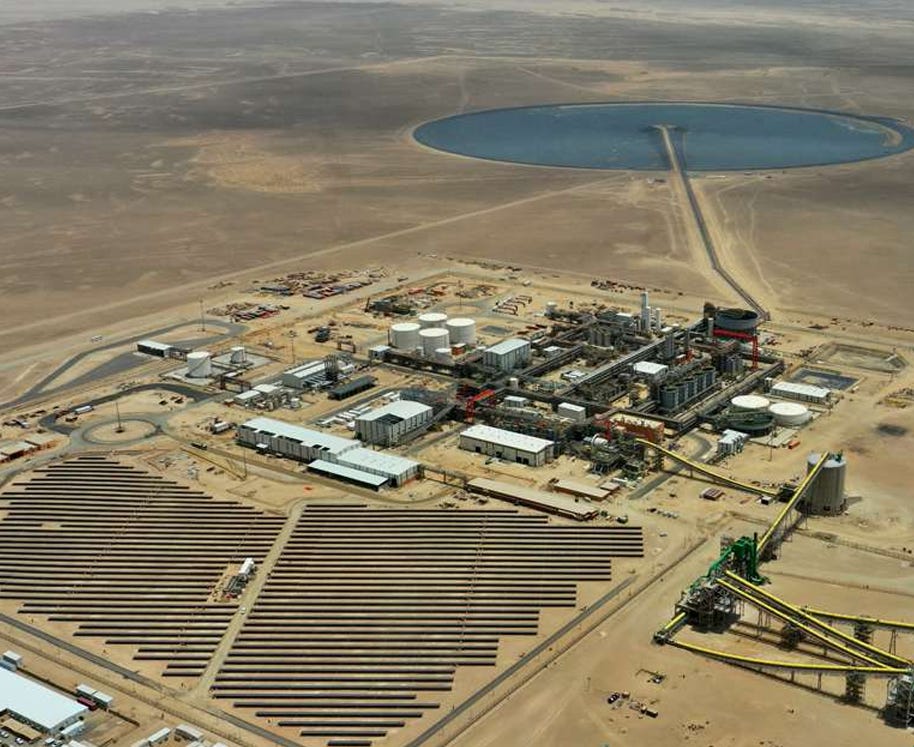
Source: Saudi Arabian Mining Company (Maaden) Annual Report 2023
Finding and extracting critical mineral ores, the upstream process, is not the hardest problem. The bigger challenge is midstream: finding places willing and able to refine those ores into pure critical minerals for downstream manufacturers of EV batteries, permanent magnets, semiconductors, and other products. The refining process is chemically intensive, energy-demanding, water-dependent, land-hungry, and environmentally contentious. Saudi Arabia is building a case that it holds a comparative advantage in hosting midstream processing, developing a “mine there, process here” model—in which critical mineral ores are extracted at their source and shipped to the Kingdom for refining—for both domestic mineral ores and imported ore concentrates. Currently, the Kingdom is leveraging its cheap energy, strong government finances, desalinated water, strategic logistics, vast arid land, expanding renewable energy, and centralized industrial planning. Other countries have tried to localize refining - most notably, Indonesia’s “mine here, process here” nickel policy relies on export bans to drive processing onshore. Saudi Arabia’s model differs structurally: rather than requiring investment through export restrictions, it aims to attract midstream processing by offering cost advantages, integrated infrastructure, and management localization, making the Kingdom a commercially competitive hub for refining ores sourced worldwide.
Refining, Not Mining, Matters More
Midstream processing of critical minerals often requires substantial power, freshwater, and chemical inputs. It also demands waste management and transport systems. As it often generates more hazardous wastes and air emissions than upstream extraction, it intensifies political sensitivities. Therefore, it is hard for midstream operators to find governments willing to permit their polluting activities. In places with strong regulatory consultation requirements or large nearby populations, these facilities face years of permitting battles, litigation, and community opposition. Although many places have critical mineral endowments, only a few have the right comparative advantage and a willing government to host midstream processing. The critical minerals question is shifting from “Where are the ores?” to “Where to process the minerals?”
Saudi Arabia’s Comparative Advantages
Saudi Arabia has several crucial comparative advantages that support its “mine there, process here” model. Its first comparative advantage is energy from fossil fuels and renewable sources alike. Critical minerals processing, such as electrochemical separation and materials handling, requires abundant, reliable, and cheap power. Saudi Arabia’s low-cost hydrocarbons satisfy the bread-and-butter electricity demand of refiners. Meanwhile, renewable energy projects, such as Al Shuaibah Solar and Dumat Al Jandal Wind, have posted some of the world’s lowest renewable electricity tariffs. Although the renewable energy projects in Saudi Arabia use specific power-purchase structures rather than system-wide pricing, they have set precedents for dedicated low-cost renewable supplies for midstream processors.
Saudi Arabia’s supply of both fossil power and renewable energy helps attract midstream processors. As more corporations face sustainability disclosure rules, carbon reduction is becoming a competitive factor rather than just a reputational one. In practice, a refinery on the general grid still largely gets its electricity from fossil fuels. However, midstream processors in Saudi Arabia can build additional, separate facilities powered by dedicated renewable energy, enabling them to market their purified critical minerals as “low-carbon” to buyers whose ESG commitments or regulatory obligations favor lower-carbon inputs. Saudi Arabia’s edge is not that it has solved industrial decarbonization, but that it can plausibly support both conventional and lower-carbon processing of critical minerals.
The second comparative advantage is space. Heavy industry requires land where governments can zone activity, build infrastructure, and manage waste without encountering dense populations or entrenched local opposition. As the largest country in the Middle East by area, Saudi Arabia has vast expanses of arid territory to site industrial activity away from major cities. The Kingdom remains sparsely populated by international standards, with a population density of 42.5 people per square mile, a fraction of the world’s average of 141, and Indonesia’s 388. More than 85 percent of the population is concentrated in cities. The Kingdom’s main mining and minerals-processing centers, including Ras Al-Khair Industrial City on the east coast and Wa’ad Al-Shamal Industrial City in the Northern Borders Region, are located away from the country’s largest cities.
Saudi Arabia’s spatial advantage extends to governance. A dedicated authority, the Royal Commission for Jubail and Yanbu (RCJY), oversees heavy industries and manages four purpose-built industrial cities, Jubail Industrial City, Yanbu Industrial City, Ras Al-Khair Industrial City, and Jazan City, that bundle land, infrastructure, utilities, permitting, and logistics. Midstream processors of critical minerals in the Kingdom can therefore benefit from a more efficient siting regulatory framework than that found in ecologically fragile mining areas. For instance, the approval process under the RCJY is exempt from the national requirement for public consultation and for 5 or more years of baseline air and water data in Environmental Impact Assessments—requirements that significantly lengthen approval timelines elsewhere: as in Chile (as long as 12 years), the Philippines (11 years), and Brazil (4 years). This integrated governance structure eases one of the most persistent barriers to expanding midstream capacity, making Saudi Arabia competitive in attracting investment across the value chains of critical minerals.
The third comparative advantage is water engineering. Water is essential to leaching, cooling, chemical handling, and waste management. Saudi Arabia’s natural freshwater scarcity would seem disqualifying. However, decades of large-scale desalination experience offer the Kingdom a different pathway: desalinated water, while costly, can support high-value industrial uses, such as critical minerals processing. Desalination solves the freshwater constraints, but its siting introduces a trade-off. In Saudi Arabia, the most significant critical mineral prospects lie in the Arabian Shield, inland from the coasts. Meanwhile, major desalination and industrial infrastructure is located at the Red Sea coast. Processing can be sited inland near mines, requiring water transport, or in coastal industrial zones, requiring transport of ore concentrates. In practice, the coastal model may prove more strategic, given that port-adjacent processing infrastructure can handle both imported and domestic ore concentrates.
Saudi Arabia’s fourth comparative advantage lies in logistics. Saudi Arabia lies between the Red Sea and the Arabian Gulf, centrally located between upstream African critical mineral producers and downstream manufacturers in Asia and Europe. Saudi Arabia’s “mine there, process here” model hinges on moving ore concentrates in and refined products out at scale, with predictable customs, storage, and transport. Compared to more distant processing hubs in Asia, Saudi Arabia offers shorter sea routes from Africa, reducing transport costs for critical mineral producers in Africa.
The Kingdom’s port and rail infrastructure underpins this model. Deep-water gateways, including Jeddah Islamic Port, King Abdullah Port, and the Jazan City for Primary and Downstream Industries port, are equipped to handle bulk mineral cargo. These coastal complexes are integrated into Special Economic Zones that provide bonded storage and streamlined customs procedures, and are linked to the interior by the Saudi Railway Company’s heavy-freight network. As an integrated system, these logistics networks position Saudi Arabia as a potential midstream processing hub for both domestic ores and imported concentrates.
Finally, Saudi Arabia’s domestic critical mineral endowments strengthen the Kingdom’s midstream strategy. The Saudi government estimates the Kingdom’s mineral wealth at roughly $2.5 trillion, though these are state figures intended partly to attract investment rather than independently verified valuations. Still, the Kingdom has documented deposits and reserves of gold, titanium, copper, phosphate, bauxite, and other minerals, several of which appear on major critical minerals lists. Foreign investors appear to regard this resource base as commercially credible: by 2025, they accounted for roughly two-thirds of bidders for mining licenses in Saudi Arabia. The Kingdom’s own upstream mineral production provides a reliable feedstock base for its midstream processing.
Saudi Arabia already has a track record of processing raw minerals. The Kingdom’s phosphate sector demonstrates its industrial capability, not merely ambitions. In 2025, Saudi Arabia ranked sixth globally in phosphate production through Ma’aden, a publicly listed mining company under majority state control through the Public Investment Fund, a $941 billion sovereign wealth fund. This public-private structure gives Saudi Arabia a vehicle with capital and bargaining power in negotiations with foreign investors, including negotiations over technology transfer and management localization.
Scale, Agglomeration, and Path Dependence
These comparative advantages do not simply add to one another; they compound through scale, clustering, and reinforcement. Saudi Arabia’s integrated infrastructure supports economies of scale, potentially reducing per-unit costs across shipping, storage, and processing. Lower unit costs would make Saudi facilities more attractive to additional processors and investors, while also encouraging related activities—from chemical suppliers and engineering services to logistics firms and commodity traders—to co-locate. Over time, such agglomeration could produce path dependence: once buyers, suppliers, and infrastructure are concentrated in one hub, future investment tends to deepen that hub rather than recreate it elsewhere. History shows a pattern: financial infrastructure follows physical concentration. Chicago’s commodities exchanges emerged because the city first became the physical hub for grain storage, trade, and shipment. If Saudi Arabia achieves sufficient concentration in refining and logistics for critical minerals, financial infrastructure could follow.
Indonesia’s Model: “Mine Here, Process Here”
Indonesia is the clearest recent example of state-driven midstream localization. In 2014, the Indonesian government began imposing export restrictions on raw nickel ore and introduced a downstream industry policy to push firms to build onshore processing capacity. Its “mine here, process here” policy succeeded. Indonesia has now transformed from a major exporter of raw nickel ore into a major exporter of higher-value nickel products.
A 2024 U.S. International Trade Commission working paper indicates that Indonesia’s exports of raw nickel essentially ceased after the ban, while exports of processed nickel products surged alongside increased foreign investment. Before 2014, Indonesia had only two nickel smelters. The number increased to at least twenty-nine by 2021. Indonesia’s export mix has risen from raw ore to higher-value ferronickel, matte, and other intermediate products.
Despite all of that success, Indonesia’s “mine here, process here” model incurs social costs. Carnegie Endowment for International Peace’s research on the Morowali Industrial Park, a major nickel ore processing hub, shows that although the park brought infrastructure, jobs, and industrial upgrading, it also led to labor tensions and strained local livelihoods. The park relied heavily on foreign capital, technology, and management. The foreign dependence was so heavy that local employees perceived they had little chance for promotion or participation in management, and local communities felt their voices were ignored. Indonesia’s model raises questions about how much control and value remain in local hands.
Saudi Arabia’s Model: Management Localization Too
Saudi Arabia’s “mine there, process here” model differs from Indonesia’s “mine here, process here” model in three ways. First, Saudi Arabia avoids the onshore upstream-midstream price distortions created by Indonesia’s export-ban model. Indonesia’s restrictions on raw ore exports depressed onshore ore prices below international levels, effectively transferring value from miners to refiners. The Indonesian Ministry of Energy and Mineral Resources indicates that nickel ore in Indonesia is sold to domestic midstream processors at discounts of around 50 percent to international prices; market news sources report similar discounts of about 50 percent. By contrast, the Kingdom’s Mining Investment Law grants exploitation licensees the right to sell minerals domestically or internationally and to export them for commercial purposes, without imposing export bans or price controls. Because miners are free to sell to any buyer at home or abroad, no structural mechanism exists to depress domestic ore prices below international levels. Domestic ores and imported ore concentrates can therefore be sourced at prices closely aligned with international markets, reducing one major source of allocative distortion.
Indonesia’s export restrictions function like an implicit export tax on upstream producers; Saudi Arabia seeks to attract midstream processing through comparative advantages such as cheap energy, state-built infrastructure, streamlined permitting, and centralized industrial planning. The Ma’aden–MP Materials rare-earth joint venture announced on November 19, 2025, for example, is designed to “leverage Saudi and global feedstock,” sourcing ore concentrates from international markets rather than relying on a captive domestic supply shaped by export controls. Under Saudi Arabia’s model, the cost of supporting refining is borne by the state budget rather than by domestic upstream producers. Its strategy is therefore not about forcing midstream investment through export bans, but about making the Kingdom a commercially competitive location for midstream processing.
Second, Saudi Arabia could present a lower-carbon processing narrative than Indonesia. Whereas Indonesia’s nickel boom has been closely tied to captive coal power, Saudi Arabia offers a plausible approach to pairing at least some refining capacity with dedicated renewable energy. Although that approach remains contingent and partial, in markets where buyers are increasingly sensitive to embedded emissions, it could still prove a meaningful differentiator.
Finally, the Saudi government deploys a management localization strategy. Leveraging its financial clout, it negotiates with foreign companies investing in midstream processing to structure joint ventures that progressively place Saudi nationals in managerial roles. By contrast, Indonesia relies heavily on foreign capital, leaving nickel processing management to foreign firms. The Ma’aden–MP Materials joint venture illustrates the Saudi strategy. Through Ma’aden, the Saudi government holds at least a 51 percent stake and retains managerial control of the facility, while MP Materials contributes technical expertise. This joint venture arrangement creates a structure that enables Saudi nationals to increasingly occupy management positions across engineering, chemical processing, logistics, and commerce. Across joint ventures and over time, the Kingdom can build up local management expertise to climb the value chain of critical minerals. Together, these three features of undistorted upstream pricing, a lower-carbon processing narrative, and management localization distinguish Saudi Arabia’s approach from Indonesia, positioning the Kingdom to build domestic capabilities.
Outlook
Saudi Arabia’s “mine there, process here” model is building a critical minerals hub whose self-reinforcing logic—comparative advantage attracting scale; scale enabling agglomeration; agglomeration producing path dependence—will be progressively harder to replicate elsewhere. In particular, the Kingdom’s management localization strategy goes beyond hosting industrial capacity; it is intended to cultivate domestic human capital. The accumulated local expertise will likely support Saudi Arabia’s broader ambition to advance the value chain of critical minerals, paving the way for downstream manufacturing. If the Kingdom executes this physical integration effectively, it could eventually leverage its physical market dominance to expand into the financial sector, hosting a global exchange for trading critical minerals and derivatives.
The sooner Saudi Arabia achieves sufficient scale and clustering in its midstream processing for critical minerals, the harder it will be for competing countries to match its unit costs. Even where governments are willing to absorb the upfront capital costs of domestic refining, local midstream processing may struggle to compete with the Kingdom’s established infrastructure and supplier networks.
The biggest threat to Saudi Arabia’s model stems from the political ambitions of mineral-producing countries. The Kingdom’s strategy rests on the presumption that cost efficiency and comparative advantage drive global supply chains of critical minerals. However, governments in Africa, such as Nigeria and other mineral-rich countries, may prioritize domestic industrialization over cost efficiency, pursuing their own localized processing mandates. If these countries restrict ore exports, Saudi Arabia’s “mine there, process here” model would lack sufficient ore to maintain economies of scale. Geopolitics can override economics.

Nathan Hu, a freshman at Columbia College, enjoys connecting economics with commodities and financial markets, technology, geopolitics, law, and psychology. He has published several original research articles spanning these fields. In his free time, he enjoys playing tennis, running, and spending time with friends.