


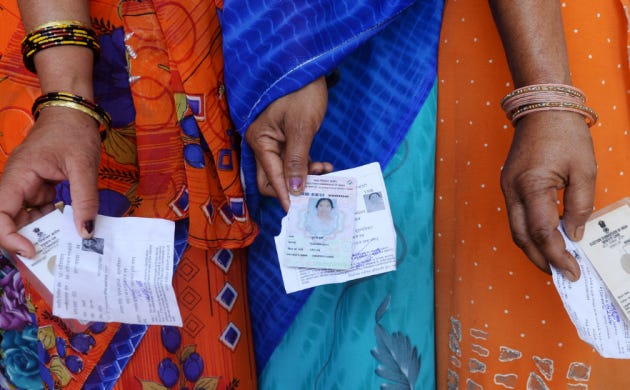
Just a few years ago, people in New Delhi had to deal with the hassle of paying in cash. It was once tedious, slow, and impractical for a country the size of India. Now, PayTM’s technology has revolutionized the industry, enabling people to pay with a simple scan of a QR code. Similarly, people could not be identified simply because they did not have birth certificates or any other valid form of identification. Aadhaar, one of the major DPI systems in the country, has helped people establish a form of universal identity, enabled them to open bank accounts, and facilitated the transfer of benefits and subsidies into the bank accounts of beneficiaries. India’s state-led strategy has contributed to increased inclusion, while also revolutionizing how people interact with the country’s banking systems. By integrating India’s public-good approach with the similar systems of Ukraine and Brazil, this article argues that the Digital Public Infrastructure (DPI) model offers a positive framework for emerging markets seeking to grow indigenously.
Introduction to DPI
Digital Public Infrastructure (DPI) has slowly evolved to become the future of country development, efficiently connecting citizens, corporations, and governments to exchange and access goods and services. Within a country’s digital landscape, DPI, which is a burgeoning global concept, enables citizens to engage with the government and pursue economic opportunities. These platforms, including data exchange systems and identification and payment systems, allow countries to provide services to citizens with greater ease and accuracy. In an era defined by rapid digitization and technological expansion, the value of DPI cannot be overstated. DPI is frequently likened to roads: just as physical roads provide access to goods and services, digital public infrastructure opens pathways for economic opportunity across sectors such as healthcare, retail, and agriculture.
The key aspect of these technologies lies in the fact that they are ‘public.’ The word helps us form a relationship between the entities providing this infrastructure (governments) and the people who are utilizing them (the common man). These systems enable the community to utilize large amounts of data with a single click. Whereas previously, data was manually collected and analyzed, these technologies have enabled governments to monitor and better understand their people. DPI helps the average person by making essential services—identity, payments, and documentation—fast, low-cost, and accessible. It removes friction from daily life, letting people access money, prove who they are, and receive government support securely.
India’s DPI Model
The need to assimilate data is especially urgent in India, whose vast population and diversity far exceed the capacity of its physical infrastructure. DPI systems have allowed millions of people to access ID, give and receive payments, and connect to state services. These systems have not only allowed the delivery of services, but also changed the way the government understands its citizens. These records produce a digital footprint that is produced in machine-readable terms.
In India, the change that has come about can be attributed to Prime Minister Modi’s appointment in 2014. In 2023, he launched two initiatives: the Global Digital Public Infrastructure Repository and a Social Impact Fund. These are aimed at advancing DPI in the Global South, including countries such as Brazil. Fifteen years ago, one-third of the population (approximately 400 million people) had no form of official government identification. For a country with more than 60% of the population living in rural areas with no access to healthcare, this does not come as a surprise.
Administered in 2009 by the Unique Identification Authority of India, Aadhaar has emerged as the country’s digital identity system. Aadhaar provides a “population-scale biometric-based authentication service that is the foundation for people to access government welfare schemes.” By 2022, around 1.3 billion citizens were registered on Aadhaar. Direct Benefit Transfer (DBT) schemes can also be administered now with the ability to map a person’s Aadhaar ID with a bank account. This has allowed cash to be transferred directly to a person’s bank account. The tedious process of receiving and depositing cash can now be avoided. Aadhaar is also used to distribute subsidised food grains from stores within the Public Distribution System. People’s fingerprints are recorded in a database, after which Aadhaar users can authenticate themselves whenever they are carrying out a cash withdrawal or claiming their food entitlements. While the Aadhaar system has helped illiterate and low-income populations, the issue is not yet fully resolved.
Another initiative in the India stack is one towards paperless governance, launched by the Government of India as a part of the Digital India initiative. DigiLocker allows for the digital issuance and verification of documents and certificates. The platform involves documents such as a driver’s license, marksheets for the Board examinations in India, the Aadhaar card, and municipal-related documents. The platform has resulted in over 6.27 billion authentic digital documents being made available to over 196 million registered users as of 2023. These digital systems demonstrate that India’s model has been primarily driven by the state, in response to the country’s needs.
Export of India’s DPI and its implications
India’s model can be applied to emerging economies for various reasons. Firstly, developed economies do not face the problem of ‘identity voids.’ In places where passports and identity documents are offered from birth, people are more easily identifiable. However, in developing countries, a lack of identification can mean people cannot access government services. DPI helps remove the obstacles faced by low-income and marginalized communities, and Aadhaar in India has helped enable 50% of Indians to open their first bank accounts.
Additionally, due to weak physical infrastructure and supply chains, informal entrepreneurs face increased limitations in terms of being able to establish themselves as credible employers. The Open Network of Digital Commerce (ONDC) in India (another form of DPI) allows every seller the opportunity to connect with customers. For example, Namma Yatri, an ONDC-powered service for booking transport in Bengaluru, has seen 5 million trips within its first 6 months.
However, in order for India to successfully replicate its model in foreign countries, there are certain conditions that must be satisfied. Independent DPI steward institutions that are held accountable by stakeholders must be established to ensure the smooth export of India’s principles. India should also lead a multilateral dialogue that is focused on meeting the needs of developing countries to ensure they do not fall prey to the regulations of developed countries. Lastly, India needs to develop a sustainable financing model to ensure the viability of their services is systematically applied. This model should not be led only by philanthropic funding.
Comparisons with Ukraine and Brazil
Countries like Ukraine and Brazil have also developed very similar models. Ukraine’s digitization journey began due to anti-corruption protests in 2014, which led to the development of an e-procurement system called ProZorro by tech entrepreneurs. This saved the government $1 billion annually and became a global model for transparency. In 2019, President Volodymyr Zelensky launched the ‘state in a smartphone’ initiative, which aimed to offer citizens government services online. His administration established the Ministry for Digital Transformation and developed a structure that allowed for digital literacy and e-governance.
Ukraine’s digital public infrastructure stems from the Diia app and the Trembita data-exchange platform. The latter was introduced in Ukraine to ensure the secure exchange of data between users and state databases. Diia, on the other hand, allows citizens to access documents and public services through their smartphones, similar to DigiLocker. Russia’s invasion in 2022 led to the platform extending its offerings to wartime needs. Diia is now being shared globally with the help of USAID to support e-governance reform.
The key distinction between the two models is that Ukraine operates a centralized, state-managed system, whereas India’s DPI is distributed across multiple government agencies due to the scale of its population and administrative demands. This distinction fits each country’s needs: Ukraine’s unified user experience can enable policy changes to be implemented more efficiently through one or two platforms. However, any failure in these systems can result in a loss of access for everyone at once. India’s more distributed model is harder to coordinate and can feel fragmented, but because it has multiple layers, the failure of one system does not leave everyone unable to access the others. India’s federal and heterogeneous nature is well-equipped for this model.
Similar to Ukraine, Brazil’s model is also centralized. Through its two core pillars–Gov.br and Pix–Brazil’s model aims to expand citizen access and public sector efficiency. Gov.br is a digital identity system, similar to Aadhaar, which integrates fragmented ID systems (when multiple institutions or agencies within a country issue their own ID). It serves and focuses on secure access for digital signatures. Pix, on the other hand, was created by the Central Bank of Brazil and provides free transfers between individuals and businesses. In Brazil, World Bank funding has supported digital literacy programs to expand access. A national data policy has been announced, outlining where and how a person’s data will be used. Although none of these technologies can be exported, Brazil is a proponent of the benefits of DPI for development.
Ukraine’s model shows how critical DPI is for garnering citizen trust, especially during times of war. DPIs can ensure resilience even when physical infrastructure might fail. It allows the state to respond quickly during emergencies and maintain the legitimacy of the people. Brazil’s model similarly shows how DPIs ensure that inclusion applies to everyone, not just a select few. These case studies show that DPI is not just a mere technological advancement; it is a tool for governments to remain connected with their citizens and remain functional under a variety of conditions. Whether it’s during a war or economic inequality, DPI keeps services accessible.
Conclusion
Together, India, Ukraine, and Brazil reveal that DPI is not just about efficiency, but also about empowerment. These nations demonstrate that just as roads and railways were the backbone of the 19th and 20th centuries, DPI has become the new backbone of the 21st century, linking identity, payments, and commerce into one ecosystem. Developing economies like India can benefit from this system, which transforms technology from a private luxury into a public right, ensuring that growth is built and shared collectively, devoid of inequalities.