



The ramifications of the Russo-Ukranian war extend well beyond the battlefield, bringing turmoil in the Greek territory: gasoline prices spiked, revealing a strong energy dependence on Russia’s oil structures. During and after Russia invaded Ukraine in February of 2022, Greece didn’t sufficiently develop internal energy sources, but rather focused on establishing energy import agreements with other countries, furthering Greece’s dependence on external powers and leaving the country vulnerable in the case of future energy crises.
March 15, 2022, marked a significant date for the European Union energy sector; the EU prohibited purchases of Russian gasoline, diesel fuel, and other refined petroleum products. On the same day, the EU banned the supply of energy-related equipment, technology and related services to Russia, in addition to banning new investments in the Russian energy sector. As a direct result of these new laws, Russia’s share of EU gas imports dropped from over 40% in 2021 to only 11% in 2024. These new bans gave way to an energy crisis, as Russia was the primary gas supplier for a majority of EU countries including Germany, Italy, and Greece, to name just a few.
In direct consequence to this energy crisis, Greece’s energy prices skyrocketed. For example, in 2024, the retail price of diesel in Greece was $1.79 per liter, making it the ninth most expensive in the EU. Similarly, electricity prices increased 35% in Athens from January 2021 to January 2025, while many other European countries saw a decrease in prices. In response to these rapidly rising prices, Greece sought alternative external energy sources.
Greece’s natural gas supply has traditionally relied on three main sources: the Trans-Adriatic Pipeline (TAP), which delivers gas primarily from Azerbaijan; the TurkStream pipeline, which transports Russian gas to Greece; and the Revithoussa liquefied natural gas (LNG) terminal, which receives LNG from the United States, Algeria, and Russia. Following Ukraine’s invasion in 2022, Greek Prime Minister Kyriakos Mitsotakis expressed his support for the TAP pipelines expansion during the COP29 climate conference in Baku. Additionally, in August 2022, a new floating storage unit at the LNG terminal in Revithoussa, owned by the Greek company DEFSA, started operations. Accordingly, in September 2022, Greece’s largest utility, DEPA Commercial, clinched a deal with the French company TotalEnergies for the supply of LNG in an effort to reduce its reliance on Russian gas. Thanks to the new storage unit, LNG cargoes doubled not only for TotalEnergies, but for Greece as a whole. Greece now sources more than 80% of its LNG imports from the US, while gas imports from Russia have halved. Earlier this fall, in November 2025, Greece signed an agreement to import 700 million cubic meters of U.S. LNG per year starting in 2030, signaling the continuation of this US dependence.
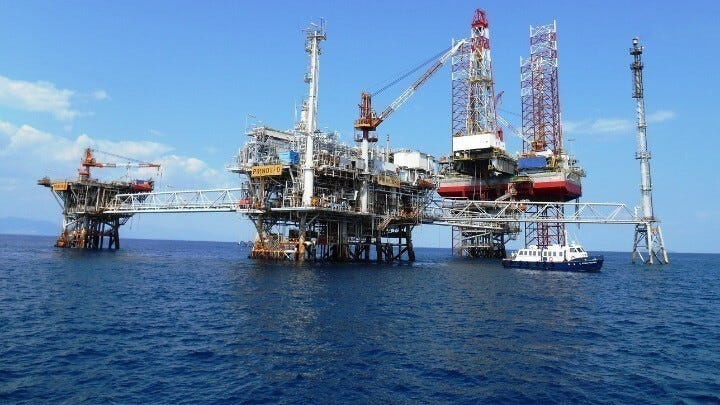
Despite Greece’s efforts to diversify its gas resources, Greece has done little to develop its domestic gas supply. Regions surrounding Crete and the Ionean Sea hold a significant amount of recoverable natural gas reserves—15 billion barrels of oil, which is enough to fuel Greece for approximately a thousand years. Yet, instead of mobilizing these domestic reserves, Greece turned to external support, furthering its international dependence. This trajectory marks a clear missed opportunity for Greece, as the Russo-Ukraine induced energy crisis could have propelled Greece to harness its natural gas deposits rather than deepening its dependence on external powers. These natural gas deposits could transform Greece’s role: instead of relying on others for gas and being a transit corridor for energy resources, it could become an active-producing nation.
Moreover, Greece’s newfound turn to international LNG imports furthers its vulnerabilities from external market exposure. Greece might heed warning from the case of Pakistan, a country which historically imported large quantities of LNG from Qatar and Eni. Following Ukraine’s 2022 invasion, global LNG prices skyrocketed, with Europe buying up massive LNG cargoes to replace lost Russian pipelines. Notably, LNG agreements are destination flexible, meaning that the seller can redirect the cargoes if the market price makes it favorable. As a result, Pakistan could not compete with wealthier European nations and suddenly found itself out of the LNG market. The result was nationwide blackouts, industrial shutdowns, and severe inflation in electricity and transport costs. In the case of another global energy shock, Greece could find itself similarly squeezed out of the LNG market, a severe vulnerability that could be mitigated by developing domestic gas productions.
Had a Greek cultivation of domestic energy resources started years ago, Greece would not have experienced such an extreme energy crisis after the Ukrainian invasion. This should be a lesson for Greece, especially as the nation continues to deepen its foreign dependence on LNG imports. Thankfully, in November 2025, Exxon Mobil, Helleniq Energy, and Energean signed a deal for an experimental historic drilling campaign in the Ionian Sea starting in late 2026, signalling a new willingness in Greece to capitalize its natural resources. That said, this slow pace and experimental phase of the new drilling would not make a difference in the face of a new energy crisis. Therefore, I recommend that Greece fast track the expansion of domestic drilling industries to stimulate and protect the local economy from foreign influence.

Sofia Antoniadou (SEAS ’29) is a writer for the Columbia Emerging Markets Review studying Biomedical Engineering. She is interested in exploring the intersection between health and technology.