



Reassessing China+1: Tariff Risk Versus Wage Arbitrage in Global Furniture Manufacturing
Introduction
For much of the last three decades, China has risen to be a dominant player in global manufacturing, particularly within the furniture and interior design industries. Accordingly, most international retailers and brands have come to source entire collections from manufacturers throughout China. Lately, however, rising wages and land costs in coastal China, a wave of increasingly volatile U.S.–China tariffs, and broader geopolitical tensions have made the old “all-in-China” approach look riskier than it once did. In response, sourcing teams have increasingly adopted what is now termed a China+1 strategy, maintaining a substantial manufacturing presence in China while deliberately adding at least one alternative production base to insulate against cost shocks and policy volatility. China+1 is therefore best understood as a risk-management hedge against geopolitical, tariff, and supply-chain shocks, rather than against traditional wage-arbitrage.
What “China+1” Means in Furniture
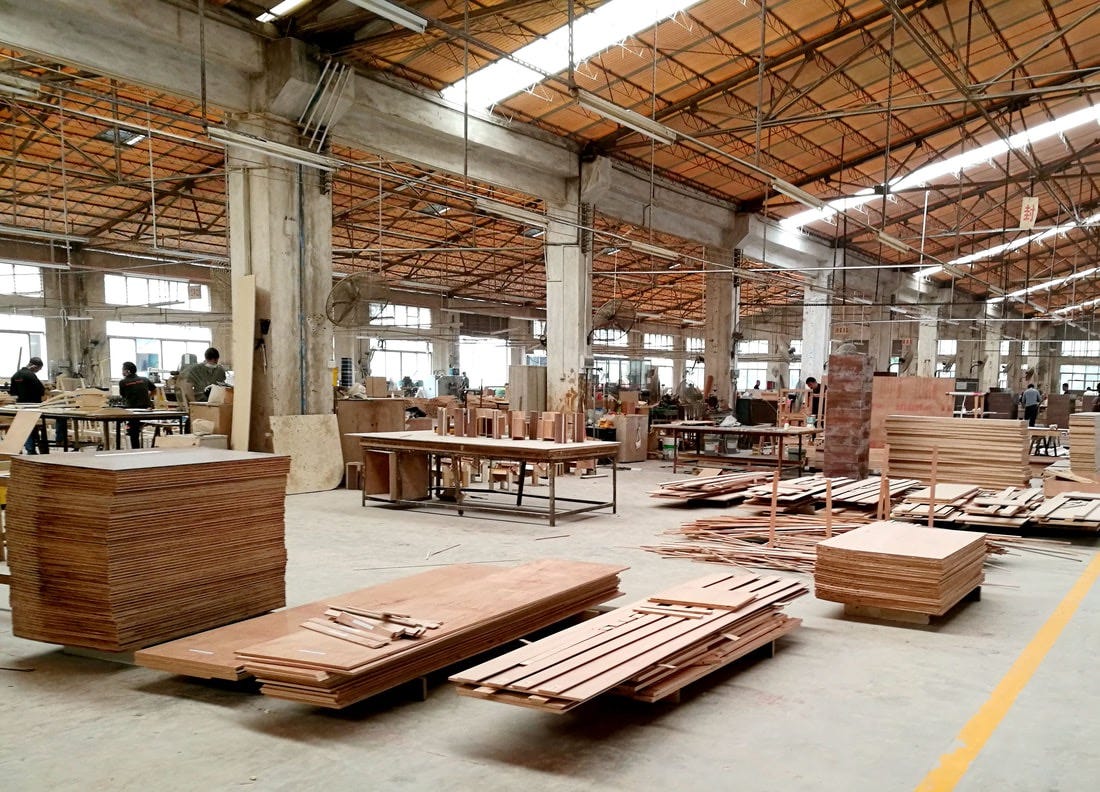
China’s furniture industry sits at the center of a dense global ecosystem that links industrial clusters in places like the Pearl River Delta and Nankang (Jiangxi) to big-box retailers and e-commerce platforms in the U.S. and Europe. On the supply side, China accounts for roughly one-third of worldwide furniture production, with output near USD 160 billion in 2023. On the demand side, the U.S. is still one of the largest importers in the world, sourcing more than USD 25 billion in furniture annually, with China and Vietnam as its top suppliers. In recent years, China provides roughly 23–29% of U.S. furniture imports, down from more than 50 percent in 2017. This combination of a highly integrated Chinese production base and an increasingly diversified U.S. import market defines the constraints faced by Chinese exporters and serves as a backdrop to the China+1 conversation..
Wage Arbitrage Vs. Tariff Policy
Discussions of China+1 commonly rely upon a straightforward cost narrative: as wages in China rise, production naturally migrates to cheaper labor markets like Vietnam, India, or Indonesia. Chinese wages have climbed drastically in the past two decades, with 2023 average urban monthly of 11,300 Chinese Yuan (roughly 1,600 USD), while Vietnam’s average monthly income was around VND 7.1 million (roughly 290 USD). Manufacturing-specific data tell a similar story, where average annual wages in China’s manufacturing sector reached about 14,500 USD in 2023, while average annual manufacturing wages in Vietnam were about 3,800 USD in early 2024. On the demand side, in 2023 the U.S. imported roughly USD 27 billion of other furniture and related component parts per year, with Vietnam supplying roughly 25% (USD 6.81 billion) and China about 23% (USD 6.4 billion) of that total. Looking solely at these wage gaps and the shifting balance/distribution between Vietnam and China in U.S. furniture sourcing, the idea that “business simply followed the cheapest labor” seems very plausible.
The timeline of the China+1 rollout, however, points to tariff and policy shocks as the main driver rather than wages alone. Before the recent tariff waves, China dominated U.S. furniture imports, in fact by 2017, Chinese suppliers accounted for roughly 60% of total U.S. household furniture imports, while Vietnam’s share was only about 13%. The wage gap between China and lower-cost Asian competitors had been widening for years, yet U.S. buyers stayed heavily concentrated in China until the Section 301 tariffs hit in 2018–19. These measures imposed punitive duties of up to 25% on more than USD 300 billion of imports from China, and many wooden and metal furniture products now carry an additional 25% ad valorem Section 301 duty. For example, Chinese wooden bedframes classified under 9403.50.9045 HTSUS (Harmonized Tariff Schedule of United States) are explicitly subject to a 25% surcharge in addition to broadband China tariffs. After these duties came into force, China’s share of the U.S. furniture imports fell while Vietnam’s rose, and by the mid‑2020s Vietnam had become the single largest supplier. In Lecong, the “Furniture Kingdom” of China, vendors reported that they have long since given up on the U.S. market and rebuilt their order books in India, Africa, the Middle East, and Southeast Asia in response to tariff pressure. Taken together, this abrupt inflection after tariff rounds provides strong evidence that policy shocks, not wage trends, were the primary driver of the restructuring of U.S. furniture import sourcing.
China’s Response to China+1
China’s response to this China+1, tariff-heavy environment has not been to exit furniture manufacturing but to retool so that it remains the most resilient node in the network. China is still the world’s largest exporter of other furniture (bedding, lamps, prefab buildings etc.), shipping about USD 27.1 billion in 2023, with the United States, United Kingdom, and Japan among its top destinations. To offset higher wages and policy risk, Chinese factories have invested heavily in automation. Chinese plants are installing roughly 280,000 industrial robots a year, about half of all new robots worldwide, helping them retain or even increase their share in labor-intensive export sectors like toys and furniture between 2019 and 2023. Production has also migrated into highly automated inland clusters such as Nankang in Jiangxi, where one highlighted bed factory reportedly produces up to 30,000 units a month with about 30 workers on intelligent manufacturing lines.
Conclusion
Taken together, this evidence suggests that wage gaps create the background conditions for China+1, but tariff and policy risk have been the decisive shock that forced sourcing teams to diversify, and that reshaped how Chinese manufacturers operate. Wages between China and Vietnam had been diverging for years, yet U.S. furniture sourcing remained heavily China‑centric until Section 301 tariffs and later rounds of duties raised the landed cost of Chinese furniture by as much as 25% overnight. Once those policy shocks arrived, buyers moved quickly, and Chinese producers responded not by abandoning the sector but by automating, shifting inland, tightening logistics links, and investing in digital traceability so they could remain indispensable even in a diversified, risk‑managed sourcing model. In that sense, China+1 in furniture is less a simple race to the lowest wage and more a risk‑management framework. Buyers keep alternative origins to hedge against tariff and policy surprises, while China’s upgraded clusters aim to stay the dominant manufacturing hub in the system.
Ardalan Tayebi is a senior undergraduate architecture student at Columbia University interested in the intersection of real estate, hospitality, and manufacturing. He researches how emerging markets, supply chains, and furniture production shape the built environment, and enjoys designing furniture and experimenting with emerging AI tools for conceptualizing 3D space. In his free time, he plays soccer and piano, listens to classical music, and likes to keep up with hospitality and real-estate news around the world.