


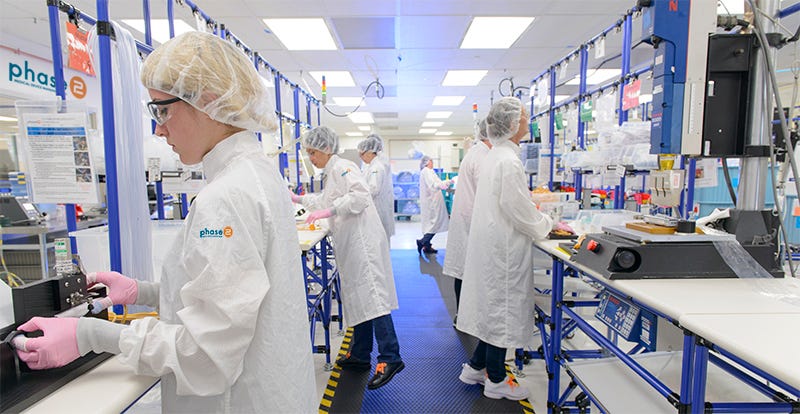
What do your invisalign retainer, the implants in your grandparent’s knee replacement, and the IVs used at your local hospital likely have in common? They were probably made in Costa Rica. The small Latin American nation of Costa Rica, well known for its stunning beaches and “pura vida” lifestyle, is a powerhouse of advanced manufacturing, as it is the home to elite global medical technology companies. These institutions, such as Boston Scientific, Penumbra, and Medtronic, dominate the worldwide market for medical device manufacturing, and their success has been pivotal to jumpstarting Costa Rica’s high economic growth and reinforcing its political stability. However, Costa Rica’s success did not happen overnight. Using Costa Rica’s triumphs as a model for economic development through the manufacturing industry, the solutions for other nations in Latin America that are struggling with similar issues of resource dependency can be made clear. Thus, in analyzing the policy implementations that defined Costa Rica’s prosperity – investments in education, support for research and development, and pioneering sustainable development – this article will present tangible, actionable policy that nations like Honduras can implement to achieve the same success.
When Costa Rica gained independence from Spain in 1821, it was a poor, agricultural, and isolated country. Capitalizing on the nation’s high altitude and fertile soil, the early government diverted the nation’s resources into coffee plantations, inevitably pigeonholing Costa Rica’s economic capacity. Struggling to match the western world’s development because of resource dependency, the government chose to invest in creating a manufacturing industry. To make the transition possible, the government enacted a series of reforms that set Costa Rica on a trajectory unlike that of any other Latin American country. Notably, the government subsidized the traditional economic liberalization regime with vigorous investment in social services to create an ideal environment for foreign direct investment. Within a few years, Intel – the world’s largest semiconductor manufacturer – established high-tech manufacturing in the Heredia province in the north-center part of the country. Building on Intel’s manufacturing base, Costa Rica transformed its economy into one of the most prosperous in the Americas. Currently, Costa Rica’s economy is strong, with 4.2% GDP growth in 2025, in large part due to advanced manufacturing – specifically medical devices and technology – which account for approximately 40% of the nation’s exports. Costa Rica’s success rests on their ability to attract FDI, bringing in $4 billion US dollars in 2024, a remarkable feat they have achieved through their investment in three key areas.
The primary factor of Costa Rica’s attractiveness to investors is its high-quality education system, which creates opportunities for economic mobility and an educated workforce. Costa Rica continues to invest around 8% of its GDP in education, enabling children from all backgrounds to access education. As a result, it has one of the highest literacy rates in the region. With 58 universities, many of which are specialized in STEM Fields, the nation produces a high-quality workforce, with around 4,000 qualified engineers graduating each year. This talent pipeline, alongside investment in skill development, has curated a skilled and qualified workforce. The guarantee of well-educated, skilled, and bilingual workers has been a driving force for investors choosing to establish manufacturing in Costa Rica. The benefit of investing in education goes far beyond creating a strong workforce, as the opportunity for economic mobility—coined the ‘Costa Rican dream’ by citizens—helps reduce poverty, gang violence, and political instability. When individuals feel optimistic about their future and confident in their government’s investment, they are much less likely to turn to gangs as a source of income, and more supportive of the government. Ultimately, Costa Rica’s ability to maintain stability and a strong workforce goes a long way in attracting FDI.
Costa Rica’s investment in research and development has transformed it from a strong manufacturing hub into a center of cutting-edge innovation, enabling it to remain at the forefront of a rapidly evolving market. Initiatives such as the National Center for Biotechnological Innovation provide a platform for collaboration between academia, industry, and government, driving advancements in pharmaceutical research and development. Collaboration between universities and manufacturers also creates opportunities for product development, allowing Costa Rica to develop cutting-edge technologies such as high-precision catheter systems and advanced in-vitro diagnostic components. The most successful companies are those able to produce consistently effective, easy-to-use, and up-to-date products at a fair cost, and given the complex nature of medical technology. Furthermore, the firms that are able to bring new products to market first benefit from patents and intellectual property protections, giving them a competitive advantage.
The final and most unique part of Costa Rica’s economic strategy is a commitment to sustainable development. In a world increasingly concerned about the impacts of climate change, an environmentally conscious industry will be the future of economic development, and Costa Rica is pioneering it. Consumer trends indicate a strong demand for more sustainable products. A recent study of over 20,000 consumers from PwC found that most were willing to pay up to 9.7% more for sustainable products. As shoppers look for more environmentally friendly products, pressure on industries to demonstrate sustainable production is growing. Steve Noble, a senior partner who co-leads McKinsey’s work in retail transformation globally, consolidated what this research is telling investors, stating that in our current economic climate, investment into sustainable business practices is one of the best bets for long-term success. This shift in favor of a greener economy is a major benefit for Costa Rica, a nation already spearheading a transition to green energy. Costa Rica is a leader in sustainability, the only tropical country to have successfully reversed deforestation, and is already launching initiatives to embrace green energy. Its national decarbonization plan and shift to green energy are attractive to investors as information about consumer interests evolves.
This policy analysis shows how real economic growth can be achieved by investing in social services and emerging industries while attracting interventional investment. For example, Honduras is currently one of the poorest countries in the western hemisphere, heavily reliant on resource extraction with limited economic growth. While the situation may seem dire, Costa Rica was in the same position only a couple of decades ago, and by following the strategy they used Honduras can achieve the same growth. Taking a page out of Costa Rica’s playbook, Honduras should move to invest in green technology development, transforming its key industries of textiles and automobile parts to make the sustainable products consumers are asking for and joining Costa Rica in leading the charge for this emerging market.
Costa Rica is redefining what the future looks like for Latin America. Analysis of the three key policy implementations that enabled their success – investments in education, support for research and development, and pioneering sustainable development – provide an invaluable guide for developing countries in the region. Following in Costa Rica’s footsteps and investing into these areas should be an absolute priority for nations looking to break free of resource dependency and attract the investment needed to develop a diverse economy with potential for growth.

Kat Mulgrew (Barnard College ‘29) is a writer for the Columbia Emerging Market Review, double-majoring in medical anthropology and neuroscience on the pre-health track. She is interested in public health in developing nations and expanding healthcare access.