


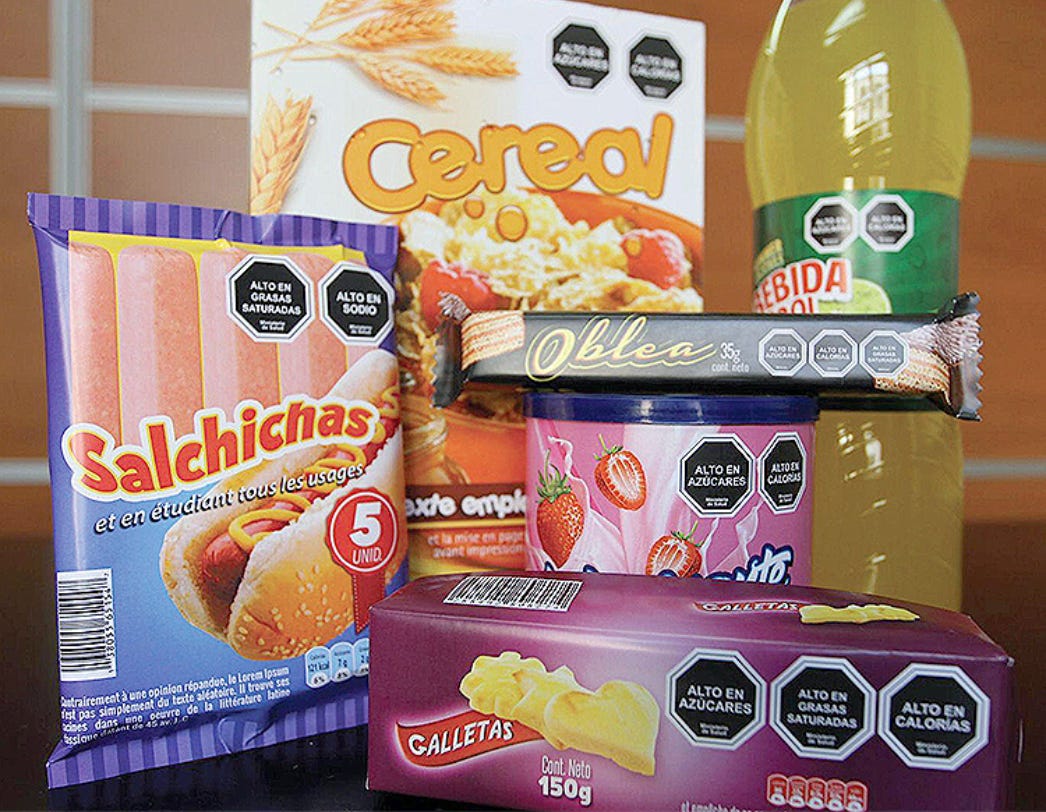
Over the past decade, the Mexican government has adopted an aggressive regulatory framework targeting ultra-processed foods and beverages, imposing constraints on their marketing and sales. Mexico has one of the highest obesity rates in the world, with roughly 70% of adults classified as obese or overweight in 2020. This statistic is driven in part by extraordinary consumption of sugary beverages and unhealthy snacks, which accounted for 23.1% of Mexican daily intake in 2020. Children are impacted by this trend as well; in fact, UNICEF found that the highest rates of consumption were among preschoolers, for whom these products comprised nearly 40% of their daily caloric intake. Faced with mounting healthcare burdens and obesity concerns, the Mexican government has begun treating food regulation as an economic policy as much as health policy. Despite seeming like a public health intervention on the surface, this measure is quietly redrawing the competitive landscape of Mexico’s food industry and forcing firms to compete on strategic adaptation rather than relying on scale-driven advantages.
Mexico introduced a one-peso-per-liter tax on sugar-sweetened beverages in 2014, mandatory front-of-package warning labels for products high in sugar, fat, or sodium in 2020, and bans on junk food sales in schools in 2025. Though states like Oaxaca and Tabasco had implemented their own health-forward regulations in 2020, these federal regulations expanded the scope of impact significantly. Thus, it was necessary for companies to adapt in order to continue reaching certain consumers in Mexico. For multinational food and beverage giants with few prior limitations in a $21 billion food-and-beverage sector (as of 2021), this represented a significant shift.
The long-run effectiveness of Mexico’s nutrition regulations, however, will depend on the government’s ability to sustain strict enforcement, which is already proving costly and difficult. Monitoring compliance across Mexico’s approximately 255,000 schools is logistically intensive, and informal vendors outside 77% of schools–where children frequently purchase candy, chips, and sugary drinks–fall largely outside the scope of direct regulation. So far, investment has still been politically viable. High-profile measures–such as the implemented soda taxes and school bans–generate immediate signaling value, allowing political leaders to demonstrate action on a widely recognized public health crisis. However, these incentives may weaken over time, leading to two possible trajectories. First, as these policies become less novel and their political returns diminish, the current governing party may face declining incentives to sustain the same level of financial and administrative commitment. Second, if political leadership changes, successor governments may have even weaker incentives to allocate substantial resources toward enforcing policies that are no longer politically “owned” by them, particularly given the high costs and diffuse benefits of enforcement. In both scenarios, gradual erosion of enforcement intensity may ease pressure on firms, allowing greater flexibility to adapt and regain competitive ground.
Despite future uncertainty, enforcement is currently in full swing for the aforementioned reasons. The consequences of these policies become most visible when examining firms that once dominated Mexico’s consumption landscape: beverage multinationals like Coca-Cola and PepsiCo, which built massive businesses around sugar-sweetened drinks and have experienced measurable constraints in volume and revenue since the implementation of these policies. For Coca-Cola’s Mexican bottler, Coca-Cola FEMSA, beverage volume declined 6.5% from 2024-2025, despite a 3.3% increase in revenue. This divergence reflects a structural challenge: demand for sugary beverages weakened under regulatory pressure and labeling requirements, strict taxes further hurt profits, and thus, firms were forced to rely on pricing to maintain revenue. This dependence is unsustainable for future growth since soda is a price elastic good within Mexico, where consumers are being encouraged to switch to healthier alternatives, regardless of price. PepsiCo has experienced similar constraints: its Mexico revenue declined 2.5% year-on-year in 2025, demonstrating direct revenue pressure in one of its most important consumer markets.
This regulatory pressure has not been uniformly distributed across firms. Mexico’s dominant domestic food company, Grupo Bimbo presents a striking counterexample, demonstrating strong economic performance over the same period. Grupo Bimbo Mexico’s revenue grew approximately 26% between 2023 and 2025 (driven by both volume and pricing), reflecting sustained demand and expansion. The company also announced a $2 billion investment in Mexico through 2028, conveying confidence in future domestic growth. Unlike Coca-Cola and PepsiCo, Bimbo’s growth has not been constrained by declining consumption volume in its core categories.
Though all three firms have responded strategically to Mexico’s regulatory environment, their adaptation capacity differs significantly. Grupo Bimbo has undertaken the most comprehensive reformulation effort. It reformulated 82% of its daily-consumption products to reduce sugar, sodium, and fat, and by 2025, 95% of its portfolio met positive nutrition standards–allowing the company to avoid warning labels and maintain steady consumer demand as tastes shifted (due to increased public messaging and education around nutrition). Bimbo also eliminated key regulated ingredients such as high-fructose corn syrup and partially hydrogenated oils, demonstrating proactive regulatory compliance. Coca-Cola and PepsiCo, by contrast, face limitations in reformulation because sugar-sweetened beverages inherently rely on sugar as a core ingredient. While Coca-Cola has expanded zero-sugar product lines (zero-sugar beverage volume grew 31% in 2024), these products represent a partial rather than complete substitution for traditional products. Coca-Cola FEMSA has also delayed some distribution investments due to regulatory uncertainty and tax impacts, indicating greater caution in expanding operations.
Comparing Bimbo with Coca-Cola and PepsiCo suggests that regulation has had asymmetric effects across sectors, constraining beverage companies more heavily while allowing food producers greater flexibility to maintain volume growth. Coca-Cola, PepsiCo, and Grupo Bimbo were initially compared because all three have enormous market scale in Mexico, guaranteeing that differences in performance reflect structural regulatory factors rather than size alone. Yet, attributing this divergence solely to sectoral differences would be misleading. To isolate whether this pattern reflects firm strategy or industry constraints, it is necessary to examine multinational firms operating within the same food categories as Grupo Bimbo.
Within Mexico’s packaged food sector, Grupo Bimbo still outperforms multinational peers like Nestlé and Mondelez International, suggesting its advantage is not purely sectoral. In 2021, Bimbo held a 13.7% market share within the health and wellness packaged food segment, while Nestlé similarly experienced strong pre-regulation growth (12–13% in revenue, 4.7% in volume), reflecting favorable demand conditions for multinationals. However, as more of Mexico’s nutrition regulations took effect and consumer patterns adjusted by 2024, Nestlé’s revenue growth slowed to 3.1%, while volume growth declined to -0.8%, indicating an outright contraction in real consumption, while Bimbo continued to thrive. Mondelez International faced a similar structural trend to Nestlé, with slight revenue increases increasingly driven by price adjustments rather than sustained volume expansion.
Grupo Bimbo’s adaptation strategy of a complete reformulation also differs fundamentally from those of Nestlé and Mondelez, contributing to its comparative success. Nestlé’s strategy stresses product diversification instead, with an announced $1 billion investment in Mexico indicating a long-term effort to develop new product lines compatible with regulatory requirements. Mondelez, meanwhile, has focused more narrowly on marketing and packaging changes (smaller packaging to fall below labeling thresholds and advertising that emphasizes taste and smaller portions rather than health claims). Regardless of strategic differences, Bimbo’s advantage also came from its flexibility to act more quickly: multinationals must balance adaptation in Mexico with global consistency, slowing their response. On the other hand, Bimbo, deeply rooted in the Mexican market, was capable of moving faster.
In spite of current trends favoring this domestic firm, Grupo Bimbo’s success cannot be attributed solely to its standing as a local company. Rather, its dominance reflects its anticipatory reformulation strategy, which allowed it to adapt more effectively than multinational competitors. Additionally, its steady investment in Mexico further reinforces its competitive position.
Beyond these established players, the strategy of new firms in Mexico’s food sector further reinforces that regulatory pressure is reshaping industry behavior at the point of entry, not just among incumbents. For example, local startup Propel Foods (founded in 2022) is building its business models around health-conscious formulation from inception, developing plant-based and hybrid protein products with nutritional profiles optimized by their AI technology. This approach ensures alignment with both regulatory standards and evolving consumer preferences, where over half of consumers report substituting toward plant-based foods (further indicating the commercial viability of health-conscious products). Similar nutrition-focused strategies appear in other emerging firms, like Smart Bites and Better Balance, demonstrating that regulation is not only altering incumbent strategies, but also setting health-conscious production as a baseline expectation for new firms–in order to fulfill newly shifted market demand.
As enforcement dwindles, adaptation improves, and firms develop compliant product lines, the competitive gap between Grupo Bimbo and multinational firms may narrow. Yet, that newer market entrants are crafting health-conscious brand identities and challenges to multinational conglomerates still prove that regulation has had significant impacts in the past five years, and is expected to continue to do so in the near future. Mexico’s nutrition regulations have disrupted the traditional growth models of multinational food and beverage firms by suppressing volume-driven expansion and forcing a greater reliance on pricing strategies. These effects have been asymmetric across sectors, with beverage companies facing sharper constraints due to the inherent difficulty of reformulating sugar-based products, while food producers retain greater flexibility to adapt. Ultimately, regulation is reshaping competition by rewarding adaptability over scale, forcing even dominant firms to compete on responsiveness rather than reach.

Hi, my name is Aarushi Deswal and I’m in the class of 2029! I’m majoring in Financial Economics, minoring in Applied Statistics, and am interested in the healthcare, fashion, and wellness industries outside of my schoolwork. Beyond academic interests, I love spin, pilates, cooking, concerts, and exploring the city!