



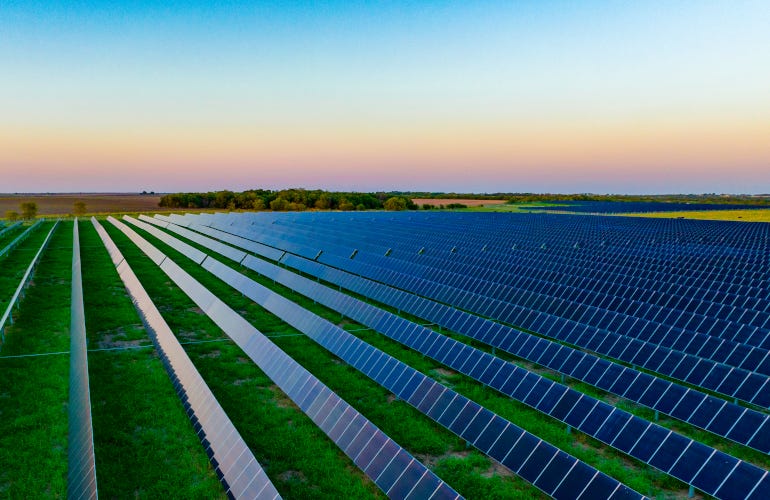
Image Source: https://www.solarpowerworldonline.com/wp-content/uploads/2023/02/stock-solar-lightsource-bp-first-solar-1.jpg
In The Middle East, oil and natural gas actually account for 95% of the region’s electricity generation. Yet today, the Middle East has become one of the fastest growing solar energy markets in the world, second only to China. Within this broader regional transformation, Israel is emerging as a frontrunner in the region, primarily because of its structured government policies designed to build a leading solar industry. Encouraging the development of solar energy allows Israel and countries around the globe to diversify their energy sources and create energy security. Israel’s government policies can be broken down into three main categories: targeted subsidies, streamlined regulation, and strategic public investment.
The Israeli government’s implementation of targeted subsidies has been a root cause of the large and continued adoption of solar energy. The country’s geography is a core reason as to why this implementation has been heavily pushed. Israel has roughly 300-330 days of sunshine per year, which is higher than the global average. Additionally, it holds expansive deserts that remain largely uninhabited, serving as attractive basis points for energy innovation and clean energy development. In order to capitalize on this geographic advantage, the government has aggressively subsidized its solar initiatives. In February of 2025, for example, Israel’s Ministry of Energy set a target to install 100,000 new solar rooftops by 2030, and is planning on accomplishing this with its tax relief and feed-in tariffs in the near future. The ministry’s goal is to reduce the barrier to entry for consumers investing in the solar energy space, which would therefore accelerate the distribution of the energy across Israel. These feed-in tariffs specifically are broken down into track net-metering programs for rooftop solar panels, which essentially allows a consumer to send back any excess energy generated back to the power grid. The Israeli government introduced multiple tariff tracks to address the issue of risk, notably through the rapid return and index-linked tracks. These were designed to shorten the investment payback period and protect the long-term tariff value against inflation, overall ensuring an above market price for excess energy produced by citizens.
Beyond these financial incentives for Israeli citizens, the government’s reforms in regulation and policy have also played a similar role in shaping the solar industry’s projected growth. In this context, administrative regulations are being relaxed in order to facilitate the adoption of solar power across the country. In 2023, the Electricity Authority of Israel decided to introduce a more loosened and easier permit process for solar energy systems in storage units. This adjustment allowed solar producers that operated on projects classified under low voltage networks (i.e. schools and farms) to connect their solar systems and battery units without complex legal conflicts. Historically, acquiring permits for these types of projects meant undergoing lengthy and expensive approval processes. This is now no longer the case. On a similar note, in early 2025, the Israeli government approved two large scale solar projects with a goal to produce over 250 megawatts of power for Israel’s national grid. These projects were taken on by Israel’s local energy companies, and were able to be swiftly implemented because of easier government regulations. The government’s intervention and effort in reducing regulations has made Israeli solar energy a less risky investment, and thus more attractive to companies and investors.
In addition to subsidies and regulatory reform, the Israeli government has also directly invested in the solar industry. These investments are targeted towards long term and sustainable projects that are deemed strategic in the advancement of solar energy adoption in the region. In February 2025, the national tender awarded contracts to build 1.5GW energy storages in Israel, which has been estimated to be valued at ILS 3 billion, or $840 million. This initiative represents a hefty commitment by Israeli authorities to boost development of solar projects in the country. Investments in research and development are also seen as strategic investments by the government, which is understood through their BIRD Energy partnership with the United States. The Israel Innovation Authority funded research projects on solar panels and battery storages in universities and private companies with the intention of encouraging technological advancement in solar energy. Specifically, these research projects are tasked with designing panels and storage units that are well suited for Israel’s dry and desert-like environment.
It is useful to compare these advancements in Israel to a similar leader in solar development in the MENA region: Morocco. Morocco has a primary focus on large and centralized solar projects funded through partnerships internationally. In August 2025, Morocco was able to finance a multi billion dollar solar power facility, the Noor Ouarzazte Solar Complex, from organizations like the World Bank, the African Development Bank, and the European Union. This project positions Morocco as a major exporter of solar energy, possibly to European countries. These projects differ from Israel’s projects that are centred around a citizen driven approach, in that Morocco is more focused on mega projects financed through international bodies. While both countries will continue to see long-term progress in the solar industry, Israel’s primary focus is doing so through government policy that encourages greater distribution, flexibility, and investment in the country.
Israel’s rise as a solar leader in the Middle East has been primarily driven by careful government policy. Particularly, the use of targeted subsidies has made solar power financially attractive to individuals and firms across the region. In addition, the implementation of streamlined regulations has promoted effectiveness and reduced challenges for investors, combined with strategic public investments that have guaranteed the infrastructure and research necessary for sustainable growth. through subsidies, regulatory reform, and strategic investment. In doing so, citizens, businesses, and investors are now encouraged more than ever to invest in the solar industry and are slowly developing confidence in its long term presence in the region.

Benjamin Halimi (CC ‘29) is a writer at CEMR studying financial economics. His interests include the MENA region and renewable energy.