


Across the Middle East and North Africa (MENA) region, the informal, unregulated ‘shadow economy’ often shines brighter than its more formalized counterpart. In Algeria, government estimates suggest that approximately $76 billion USD circulates entirely outside the formal banking system, or in the shadow economy. While mainstream economic development narratives prioritize state or foreign-led interventions, the digitization of religious giving reveals that religious institutions and their financial arms can act as alternative mediators for financial inclusion. Zakat – the mandatory Islamic alms of 2.5% on one’s assets – can be expanded through fintech infrastructure in Islamic states like Algeria, whose fintech investment has long trailed behind its regional partners. These faith-based fintech developments can accelerate the formal financialization of vulnerable populations, such as those in rural areas without reliable access to financial services, while promoting broader technological innovation and economic stability.
The core of Algeria’s financial inclusion problem begins not with a lack of resources, but a profound lack of trust. A significant majority of the population, particularly vulnerable populations like ethnic minorities and the elderly, remain wary of traditional banking due to a perceived lack of security, transparency, and efficiency. In this vacuum, religious institutions are socially and politically salient. Approximately 99% of Algerians identify as Muslim, and religious beliefs strictly prohibit riba (interest-based transactions), leading many to avoid conventional banks entirely. This general avoidance was only exacerbated by the COVID-19 pandemic; Algerian public banks experienced a fall in liquidity and subsequent consumer withdrawals of savings, highlighting the vulnerability of formal financial institutions and the need for alternatives.
Islamic finance offers a compelling alternative because it emphasizes equity-based financing and risk-sharing, rather than speculative trading or the lack of transparency in financial contracts (gharar). Zakat, specifically, serves as a built-in socioeconomic stabilizer. During periods of recession, the amount of zakat disbursed for public welfare will be higher due to reserves saved during periods of economic expansion. By redistributing income, zakat encourages investment and helps mitigate the adverse impacts of economic recessions, with secondary benefits like reducing inflation and unemployment.
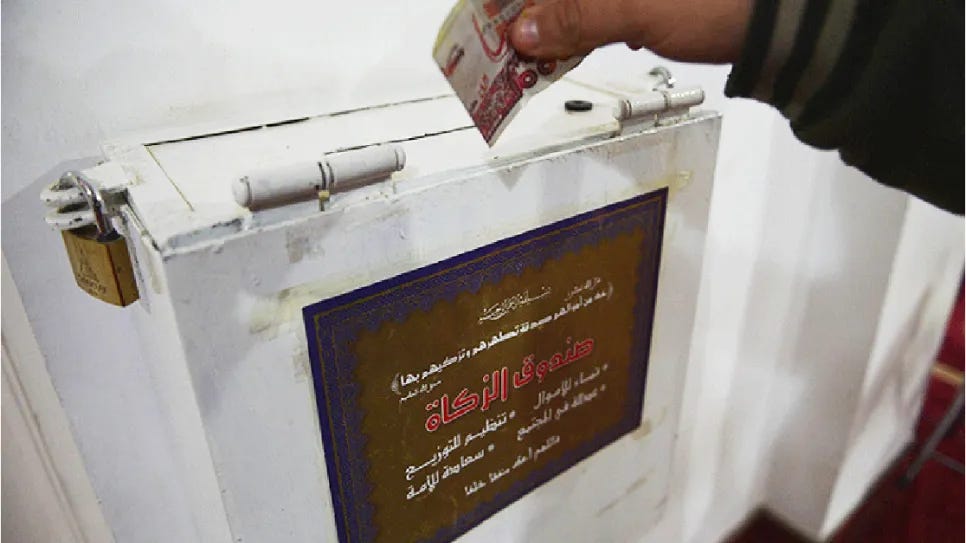
Historically, the Algerian Zakat Fund, founded in 2002 under the Ministry of Religious Affairs and Endowments, has been the primary vehicle for zakat funds. However, the Fund has struggled with managerial and governance challenges, including fund theft arising from its arguably outdated cash payment system. Here, Fintech provides a transformative solution. One alternative example Algerian researchers have pointed to is Nigeria’s Qitmeer Blockchain for Transparent Zakat Management. By recording every transaction on an immutable public ledger and automating calculations, the platform has boosted donor confidence, curbed corruption, and enhanced the impact of anti-poverty initiatives. Through the blockchain, each contributor is assigned a unique ID, with the system integrating with government databases to verify recipient eligibility and to ensure that funds reach those most in need.
To understand why digital zakat has not yet achieved total market penetration in Algeria, researchers have examined social acceptance toward Islamic fintech. A survey of 460 Algerian zakat payers conducted by Robbana et al. (2025) reveals a complex psychological landscape regarding fintech adoption. While users find the concept of a zakat platform beneficial, the research identified two negative correlations between Perceived Usefulness (PU) and behavioral intention (BI), analyzing the negative effect of service quality on PU. High-quality service is important for user convenience, but it could also be seen as excessively complicated or even less useful than traditional platforms. These findings suggest that for zakat platforms to succeed, they must focus on making the user experience more transparent, intuitive, and tailored to target communities to encourage adoption.
Fintech also offers the unique possibility of empowering vulnerable groups who have been historically excluded from financialization due to geographic and socioeconomic barriers. Mobile money is a critical driver in developing economies; the percentage of adults with mobile accounts in 2024 was 40%, which is a 16% increase since 2021. In areas where there is minimal trust in financial institutions is endemic, mobile money can promote transparency and inclusion. Still, this transition is not without risk. Vulnerable groups are disproportionately affected by digital fraud, cybersecurity breaches, and financial illiteracy. The elderly and less educated often lack the knowledge or experience necessary to navigate secure technologies. With a financial inclusion rate of only 22.59%, Algeria must develop hybrid models that integrate fintech with user-friendly designs, offering a ‘human touch’ to financial efficiency and transparency.
Despite the high domestic demand, the Algerian fintech ecosystem is still in its infancy. In 2021, only 44.1% of Algerians had a digital financial account. Several systemic barriers remain, such as high regulatory costs, infrastructure deficits, funding gaps, and talent recruitment. There is still no major Algerian ‘super-app’ that serves as a comprehensive Sharia-compliant financial services hub, unlike Malaysia’s Finterra or the UK’s Wahed Invest, making it an anomaly among its neighbors with strong Muslim communities.
While systemic challenges loom, Algeria’s potential for fintech growth is immense. The global Islamic fintech market is projected to reach $341 billion by 2029 with an annual growth rate of 11.5%. To capitalize on this momentum, Algerian governmental, financial, and religious organizations need to collaborate on simplification, education, and institutional reform. Platforms must feature user-centric, intuitive designs that prioritize transparency, especially for populations like rural or elderly Algerians. The national Algerian Zakat Fund must transition toward blockchain-based management to regain the trust of payers who prefer to give alms directly to beneficiaries. By treating zakat not just as an obligation but as an opportunity, Algeria can guide its shadow economy to the light, creating long-term development through investments in fintech infrastructure.

Audrey Jones is a freshman at Columbia University (CC ‘29) studying Political Science and Religion as a John Jay Undergraduate Scholar. She is interested in the intersections of religion and public policy, socio-economic development in the postcolonial world, and political theory. She hopes to pursue a career in academia or policy research. Audrey enjoys writing creative and academic pieces, reading, and exploring New York City’s Five Boroughs.