



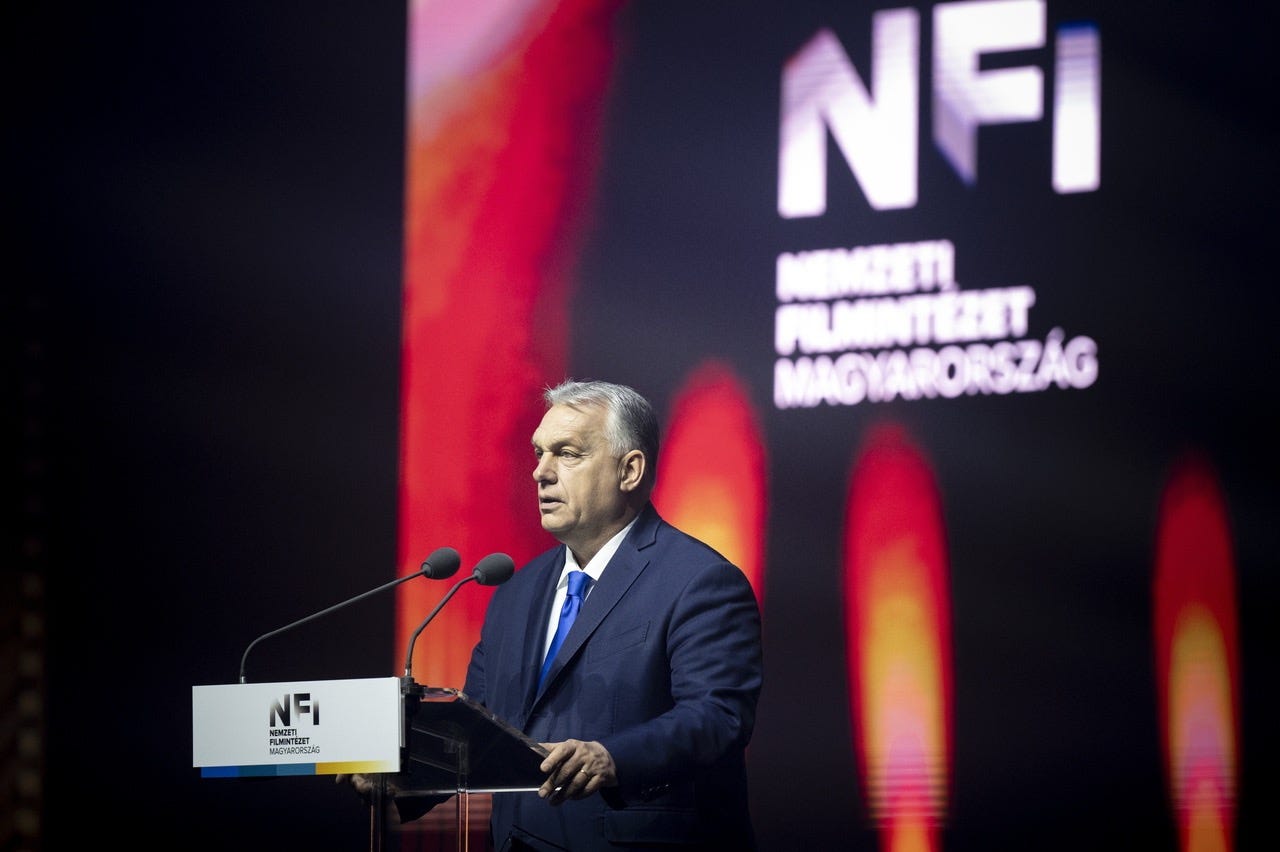
Image Source: Orbán hails Hungarian film industry as new studio complex opens near Budapest
The creative economy has rapidly emerged as one of Europe’s most dynamic areas of growth. It encompasses industries that utilize intellectual and artistic capital, such as film, design, architecture, gaming, fashion, and cultural services. According to the European Commission, the Creative and Cultural Industries (CCIs) sector generated €643 billion in turnover and €253 billion in added value in 2019. This output surpassed that of the telecommunications, high-tech goods, and automotive sectors, comprising roughly 4.4% of the European Union’s GDP. Since 2013, CCIs have created over 700,000 jobs and now employ over 8.4 million people, creating second-order effects in sectors such as hospitality, tourism, and information & communications technology (ICT). Against this broader European backdrop, Hungary’s trajectory exposes a challenge many emerging economies face: balancing rapid production-driven expansion with the difficulty of cultivating ownership and long-term creative capacity.
The performance of Hungary’s creative economy reflects both its progress and limitations. The World Intellectual Property Organization released its Global Innovation Index for 2025, ranking Hungary 38th globally in creative outputs and 9th in creative goods exports. Creative goods account for 5.7% of the nation’s total trade, signaling an unusual strength compared to other member countries of the EU. Yet, it ranked just 54th in intangible assets and 83rd in IP creation, underscoring a lack of consistency across Hungary’s various creative sectors. Domestic research asserts that while the design industry accounts for 2.1% of all exports, its added value is only 0.9%, and productivity remains 30% below the national average, underscoring the urgent need for change. Nowhere is this tension between production capacity and creative ownership more visible than in Hungary’s film industry, which presents a global hotspot for high-end production while struggling to bridge international success with domestic value creation. Although Hungary’s creative sector struggles to generate value domestically due to foreign dependence, the film industry has shown that by leveraging its production strengths, emerging talent base, and supportive policy infrastructure, Hungary has the capacity to overcome these weaknesses and build a more self-sustaining creative economy.
Hungary’s film industry has undoubtedly evolved into a powerhouse for its creative economy. In 2024, production spending approached $1 billion, representing a fivefold increase since 2018 while positioning Budapest as one of Europe’s leading filming destinations (behind only London) and earning it the title of “Hollywood on the Danube.” From Dune to Blade Runner 2049 and The Witcher, Hungary’s studios lie at the forefront of the most critically acclaimed projects. The latest phase of this expansion was the January 2025 opening of the first state-owned studio complex by the National Film Institute in the city of Fót. Speaking at its grand opening, Prime Minister Viktor Orbán noted, “thanks to developments in the film industry, it currently attracts more than 100 billion Ft (Hungarian forint) in production spending,” even generating 220 billion Ft in revenue during the pandemic year and surpassing 250 billion Ft by 2024.
Yet, this success is shadowed by a paradox: Hungary’s creative economy has thrived on international productions, but much of the long-term profit slips abroad. Particularly in film, despite offering world-class studios and one of the world’s most competitive 30% tax rebate systems with up to 37.75% with external spending, Hungary primarily serves as a production service hotspot for foreign studios. Consequently, without a dedicated shift towards domestic ownership in the creative sector, Hungary risks remaining trapped in a stagnating assembly and industrial-focused economy.
Hungary’s broader macroeconomic structure contributes to much of this imbalance. The country has long relied on Foreign Direct Investment and export-first manufacturing, particularly in the automotive and electronics sectors. For example, its “Eastern Opening” policy, introduced in the early 2010s, sought to attract Asian investment in its rail and battery manufacturing divisions beyond its traditional Western European trade relations. Similar logic has defined the creative sector, as Hungary offers infrastructure and labor, while ownership and profits often remain in foreign hands. Instead of a symbiotic relationship, the European Parliament’s 2024 report on the EU culture and creative sectors highlights the need for member states to link creative industries with digitalization, arguing that “creative-tech integration” will be central to competitiveness over the period of 2024 to 2029. For Hungary, creative-tech integration could mean aligning its thriving film industry with Hungarian-born projects rather than relying predominantly on tax incentives to enhance demand from foreign initiatives.
Budapest’s current studio ecosystem demonstrates both the opportunities and vulnerabilities in the film sector, highlighting the need to invest in fully Hungarian-made movies. This is strongly exemplified by recent developments: the capital’s five major studios are among the most advanced in Europe, and they impact far beyond the production set. As one industry executive explained, “a blockbuster doesn’t just employ film crews—it fills hotels, keeps restaurants busy, and brings a ripple effect that sustains local economies.” At the same time, these sector spillovers remain fragile due to dependence on the continuity of foreign production pipelines. When the Hungarian government temporarily froze new rebate registrations in 2025, international studios immediately paused shoots, revealing how dependent Hungary’s creative advancement is on fiscal incentives as opposed to consistent strength. The United States’ 2025 imposition of 100% tariffs on foreign-made films further raised concerns among Hungarian producers, highlighting the need for diversified revenue streams.
Similar nations in Central Europe offer valuable comparisons. The Czech Republic, while providing a lower rebate (20-25%), reinvests tax receipts into the Czech Film Fund, which supports domestic screenwriting, production, and distribution. Czech films currently represent approximately 30% of national box office revenue, eclipsing Hungary’s single-digit share. The Polish Film Institute follows a similar approach, linking its rebates to cultural content requirements that urge foreign productions to contribute to national storytelling. These models have enhanced IP retention and export visibility while sustaining competitiveness, which Hungary’s incentive-only model has yet to achieve.
Additionally, the rise of AI has added further complexity to existing challenges, namely facilitating rapid automation that has threatened higher-cost manual production. UNCTAD’s 2024 Creative Economy Outlook reported that global creative services exports rose 29% between 2017 and 2024, led by software and R&D (encompassing AI), while traditional audiovisual services remained stagnant. Hungary’s comparative advantage in skilled yet affordable on-set labor is under threat as virtual production and generative design reduce the need for physical crews. At the same time, AI opens new opportunities: Hungary’s extensive postproduction base could pivot toward VFX, animation, and digital design in order to enhance domestic revenue if supported by targeted R&D credits and EU-aligned training. Therefore, strategically integrating AI may position Budapest as a leader in digital creative services rather than solely a physical filming location.
Signs of shifts are already underway. The Hungarian National Film Institute recently launched Filmio, the country’s first national streaming platform, to promote domestic and restored cinema, while also promoting nationwide film clubs, the Classic Film Marathon, and the Hungarian Motion Picture Festival. Additionally, collaborations have been announced with regional partners from Poland and France to explore a European film streaming network, illuminating a desire to extend beyond recreationalism or service offerings. Beyond Europe, Hungary is expanding partnerships with China and filmmakers from Uzbekistan, Kazakhstan, and Turkey, building co-production networks that could diversify funding and distribution channels in emerging markets.
Meanwhile, structural headwinds add a layer of uncertainty. The upcoming 2026 parliamentary election creates an uncertain policy direction. While the current administration has been supportive of state-owned film development, future leaders may choose to prioritize other issues and curb spending. Despite boasting one of the highest shares of cultural expenditure relative to GDP in the EU, Hungary faces slowing growth and high public debt. However, if commitment from rebates is shifted to digital education and domestic enhancement, Hungary could secure long-term competitiveness instead of reinforcing dependence on seeking external capital.
Ultimately, Hungary’s cinematic rise reveals both the potential and pitfalls of development in its creative economy. The film sector’s contribution to GDP has quadrupled since 2012, yet most of that value is felt abroad, undeniably positioning it as a strategic area to further harness domestically. If the film industry continues to prioritize short-term incentives over intellectual property and digital integration, its “Hollywood on the Danube” may fade as rapidly as it rose. However, if policymakers advocate for creative sovereignty, such as by encouraging the integration of design, technology, and AI innovation, Budapest could continue its quest to redefine itself as the creative capital of Central Europe in its most enduring “production” yet.

Annabelle Lu (BC ’28) is a writer for the Columbia Emerging Markets Review studying Economics on the Political Economy track. She is interested in the political, cultural, and technological dynamics that shape investment and innovation in emerging markets.