



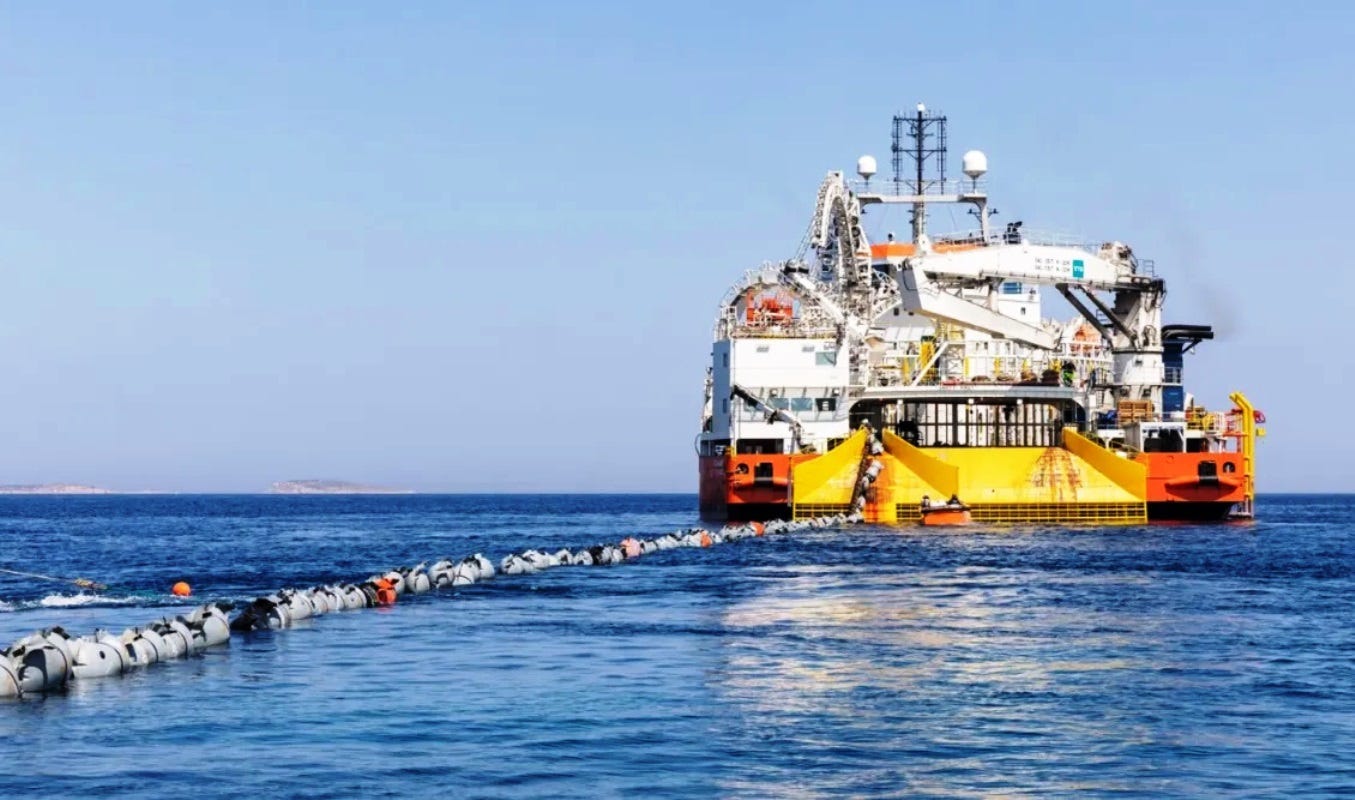
First envisioned in 2012 as the “EuroAsia Interconnector” and officially marking its beginning as a project in December 2023, the Great Sea interconnector is a subsea electric cable connecting Greece, Cyprus, and Israel. With a price tag of €2 billion, the project aims to integrate Cyprus into the European electricity grid while bolstering the energy security of EU member states Greece and Cyprus. The goal was for it to be completed by 2023; yet, as we head on to the second quarter of 2026, why hasn’t it come to fruition?
The project faces multiple challenges: its construction is technically demanding,its costs are steep, and its financial viability remains in question. That said, I believe that these concerns are less the root cause than and rather a diplomatic cover. Cyprus is using prolonged financial scrutiny as a stalling tactic to avoid making any definitive energy commitments that would expose itself to geopolitical risk, particularly from Turkey.
For context, the main sources of electricity production in Cyprus are heavy fuel oil and oil. The GSI’s aim is to strengthen and accelerate the development of the EU’s energy infrastructure. Most importantly, it also serves to connect Cyprus to continental Europe via Greece. Cyprus remains the last EU member state not connected to the European electricity grid. The complex relationship between Cyprus and Turkey dates back to 1974 where Turkey invaded Cyprus following a Greek-based military coup, resulting in the de facto partition of the island into two. Since then, Turkey does not recognize the Republic of Cyprus, the internationally recognized government. Instead, Ankara, the capital of Turkey, recognizes only the Turkish Republic of Northern Cyprus (TRNC), a breakaway state recognized only by Turkey. Additionally, the Blue Homeland Doctrine, the idea that Turkey should reclaim mercantile and maritime power in the Mediterranean, has been the driving force behind Turkey’s maritime claims. Turkey has frequently used its navy to harass drilling ships and research vessels working for the Republic of Cyprus.
Turkey reiterated its opposition to the Great Sea Interconnector, warning that it would obstruct the laying of an electricity cable linking the power grids of Greece and Cyprus. Turkish officials called the project provocative because it disregards the rights of Turkey and the breakaway Turkish Cypriots in TRNC. Despite such claims made in 2025, Greece officials pledged that work to complete the GSI would continue. That said, in December 2025, Nexans, the manufacturer of the GSI cable, cancelled tenders for work related to the GSI, officially marking a pause for the project. With financial claims being mainly on display, I believe that Cyprus’ hesitation and pause for the project stems from fear of Turkish intervention and project blockage.
Financial viability claims made by Cyprus are insubstantial. The Great Sea Interconnector has been a Project of Common Interest (PCI) for years and has been granted €657 million. The European Commission wouldn’t have granted such an amount of money had exhaustive due diligence not been conducted. The project was frozen for Greek and Cypriot governments to reassess its economic and technical parameters and to search for potential investors. At this point, 3 years after the project was supposed to be completed, the project must have already undergone exhaustive investigation by the European Commission, the European Investment Bank and the project’s current promoter, the Independent Transmission Power Operator (IPTO). For the project to receive such a grant and be a PCI, it must have been contingent on passing rigorous due diligence frameworks that verified its technical feasibility and economic necessity. The EU’s core interest in the project is energy market integration. The cable would connect the Eastern Mediterranean region into the Europe Energy Union, promoting a more reliable and unified energy market. For the Cypriot government to insist on additional, updated cost-benefit analyses at this late stage suggests a strategic procedural looping rather than a genuine quest for data. The effect is to shift the public discourse from geopolitics to accountancy. The financial studies being conducted do not actually produce new insights, but they rather produce time, thus, allowing Cyprus to remain in energy isolation while avoiding the immediate risk Ankara’s “Blue Homeland” doctrine.
While the Cypriot government claims that its primary concern is protecting the national economy, its demand for a comprehensive “geopolitical risk” guarantee functions as an unattainable standard designed to stall progress. Nicosia has pressured the European Commission and ADMIE to provide financial assurances that would protect the Cypriots in case Turkish military or diplomatic intervention halt the project’s construction. In reality, however, this is impossible: 100% risk elimination cannot be guaranteed by anyone and no regulator or insurer can offer immunity to a country against a military intervention. The project cannot move forward until the threat from Ankara is neutralized, yet the threat remains active and reveals Nicosia’s unreadiness for a definitive decision with consequences it is not ready to face.
The Ministry of Finance’s cost concerns are not without foundation. At an estimated €3 billion, the GSI would represent roughly 8% of Cyprus’s GDP and nearly a quarter of its annual government expenditure, a scale of commitment that would give pause to any small economy’s finance ministry, regardless of geopolitical considerations. The cost escalation from €1.9 billion to over €3 billion is itself significant: the increment alone exceeds two years’ worth of Cyprus’s recent fiscal surpluses. That said, these figures do not operate in a vacuum. The EU grant of €657 million, the IPTO’s estimate of €8 billion in social benefits, and the European Commission’s own due diligence all suggest the investment’s economic case remains sound. The financial concerns, while numerically real, do not easily explain why reassessment has persisted for years beyond the project’s original 2023 completion date. The current timeline is more consistent with political hesitation than genuine fiscal recalibration.
The main reason for the delay of the project being geopolitical fear from Turkey can be shown following recent updates made on the project. On April 15, 2026, the European TSO network rejected Turkish Cypriots’ plans for cable to Turkey. This announcement was made after Turkish Cypriot energy minister Olgun Amcaoglu had announced last summer that the feasibility study for a 95-kilometre two-way interconnector cable connecting Cyprus and Turkey had been completed, and that applications had been filed to TSO. The energy minister had claimed that the cable would cost less than a quarter of the forecast cost of the Great Sea Interconnector. They also claimed its operating costs would also be far lower. The European TSO said that the GSI project is the only interconnector project in its plans. Following that rejection, on April 21, 2026, Athens and Nicosia sent a joint letter to the European Investment Bank (EIB) requesting financing for the Greece-Cyprus Great Sea Interconnector (GSI), which signaled a shift away from months of inertia and points to renewed political commitment to the project. Had the project’s financial viability been the primary hurdle, this push for EIB funding could have occurred months earlier. Instead, Nicosia’s pivot from hesitation to diplomatic urgency reveals that the delay was a calculated stalling tactic, designed to persist until the geopolitical landscape was scrubbed of any viable Turkish alternative. With Turkey’s request being officially delegitimized by Brussels, the financial arguments have vanished, exposing the reality that the GSI’s biggest obstacle was never the price tag, but the shadow of Ankara.
The joint letter to the EIB was a necessary first step, but it must be followed by a concrete, accelerated action plan. Athens and Nicosia must now move to finalize the regulatory framework and accept the inherent risks of the project as a cost of national sovereignty. Further delay will only increase the financial attrition of stakeholders and signal weakness to regional rivals. The path to energy independence is now clear and unobstructed by competing proposals, thus, Nicosia must find the political courage to handle it.

Sofia Antoniadou (SEAS ’29) is a writer for the Columbia Emerging Markets Review studying Biomedical Engineering. She is interested in exploring the intersection between health and technology.