



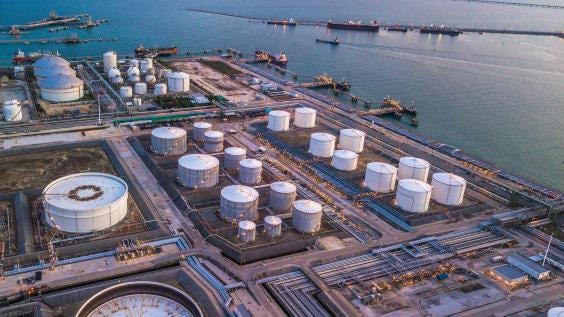
Source: https://www.bakerinstitute.org/research/power-problem-nearshoring-and-mexicos-energy-sector
In 2023, Mexico surpassed China as the U.S.’s largest trading partner, heralding a broader shift of global supply chains towards North America. Mexico exports automotive, machinery, and agricultural products to the U.S, while importing refined petroleum, vehicle and electronic machinery, and other agricultural products. A key driver of Mexico’s importance as a manufacturer is nearshoring, the relocation of factories and supply chains from countries like China closer to American markets, which has been accelerated by the implementation of the United States-Mexico-Canada Agreement (USMCA) in 2020. However, the rapid rise in manufacturing has proven to be a double-edged sword, especially in Mexico’s northern industrial hubs: electricity costs, Mexico’s primary constraint, have doubled in comparison to the costs in the US and China, water scarcity is exhausting already overexploited aquifers, and strained infrastructure is increasing costs for manufacturers. These constraints need to be mitigated through reforms that encourage private and government investment in electricity and infrastructure and boost a shift towards renewable energy.
The USMCA ensured stable, trilateral free-trade between Mexico, the US, and Canada. Companies that relocated to Mexico contributed approximately $3.58 billion in goods and services in 2023. Mexico attracts nearshoring because of its geographic proximity to the US market, its large, relatively young industrial labor force, and more accessible and free trade under the USMCA, especially as global supply chains become increasingly protectionist. Existing manufacturing sectors like automotive manufacturing, electronics, and medical devices allow firms to integrate quickly into North American supply chains.
Additionally, escalating trade tensions between the US and China, exacerbated by a series of tariffs on Chinese goods introduced during the Trump administration, have incentivized companies to shift production away from Asia. Mexico is the primary beneficiary: overland shipping from Mexico to the US takes between two and five days, while container shipments from Asia take about four weeks. The US-Israel military strikes on Iran in February 2026 and the following blockade of the Strait of Hormuz, through which approximately a fifth of the world’s oil was supplied, have made supply chains with Asia riskier and pushed companies to move production closer to the US. The geographical proximity of Mexico and the US is advantageous in a world where supply chain resilience has become a priority.
Mexico’s Foreign Direct Investment (FDI) surpassed $40.9 billion, a 15% year-on-year increase and record high, in the first three quarters of 2025. Almost a third of this capital was invested in the manufacturing sector, which is led primarily by automotive and transport equipment and accounts for almost half of all manufacturing FDI. Furthermore, sectors like aerospace, semiconductors, and electronics are also attracting investments. This matters because higher-complexity industries work with specialized suppliers and engineers, making the industrial system more attractive to other manufacturers. The Mexican Business Council for Foreign Trade (COMCE) forecasts nearshoring-related export growth of 6% in 2025 and 6.5% in 2026—if accurate, this will expand external sales toward $700 billion.
Moreover, nearshoring has geographic significance. Northern states such as Nuevo Leon, Chihuahua, Coahuila, and Baja California attract a large share of nearshoring FDI, allowing maximum use of industrial parks, skilled labor, and access to US trade routes. In particular, the Bajio corridor has emerged as a high-tech manufacturing center. The nationwide low average manufacturing wage of $4.90 per hour makes it a cost-competitive base for companies exiting or diversifying from Asia. Although FDI has strengthened Mexico’s industrial sectors, it has pushed industrial parks, energy systems, and infrastructure to their maximum capacities.
The opportunity nearshoring brings is limited by three structural constraints: electricity, water, and logistics. Mexico’s transmission grid was designed to meet national demand in 2018, not the industrial economy it has become today. According to the Mexican Institute for Competitiveness (INCO), the demand for national electricity grew by 3.4% in 2022 and 3.5% in 2023, while the transmission network expanded by just 0.09% and 0.10% in those same years. In 2023, CFE, the state electricity utility, invested only 21% of what it had planned to maintain and expand the grid. The consequence is visible: 91% of Mexico’s industrial systems have experienced power supply failures, and over 60% of the national transmission network works at almost full capacity. The worst congestion is concentrated in the northern corridors that drive the nearshoring.
To address the electricity shortage, the government has intervened through regulation. The Sheinbaum administration’s new Electricity Sector Law was published in March 2025 and mandates that CFE must supply at least 54% of all electricity on the national grid. This leaves private sector producers to supply 46% of electricity. The law also opens pathways for private sector participation, as firms that provide project development services are required to contribute to electricity generation.
Water scarcity caused by nearshoring is a more difficult problem to overcome. According to the National Water Commission, over 45% of Mexico’s aquifers in the north are overexploited in a region with the lowest rainfall in the country. Nuevo Leon, a major industrial corridor, faced protests in 2022 due to domestic water shortages as the industrial demand from new factories led to water scarcity. Across municipal and federal agencies, water infrastructure is aging, and climate change is worsening the frequency of droughts in northern Mexico. Furthermore, the new energy and semiconductor facilities are water-intensive, worsening existing water scarcity.
The logistics constraint also continues to grow as the volume of goods transported increases. The Port of Laredo, the busiest land port in the United States, handled about 3 million incoming trucks from Mexico in 2023. With increasing nearshoring, congestion has increased pressure on customs facilities and cross-border trucking capacity. A decade of underinvestment in port infrastructure has also strained Mexico’s seaports as volume grows. Cargo theft along logistics corridors further adds costs to operations. Projects like the proposed $10 billion Laredo-Monterrey freight corridor—a dedicated route that connects one of Mexico’s largest industrial cities to the busiest land port in the US—and the planned expansion of the World Trade Bridge are steps in the right direction, but will take years to be executed.
A formal review of the USMCA will occur in July 2026, determining whether the agreement is extended for sixteen years, renegotiated, or allowed to expire. The review is not a formality. One of Washington’s main concerns is Chinese tariff circumvention: manufacturers have routed goods through Mexican assembly operations to reclassify them and access the US market at USMCA rates they would not qualify for. This means that a Chinese factory ships its goods to Mexico, performs minor assembly or repackaging, and exports the product to the US under a Mexican label, using Mexico as a route to avoid the US tariffs on Chinese goods.
However, in December 2025, Mexico’s Senate approved tariffs of up to 50% on 1,463 categories of Chinese goods. This is likely to shape the decisions of the US negotiators on the USMCA: Mexico’s tariffs on Chinese goods will reassure the U.S. that its tariffs are not being evaded. A successfully renegotiated USMCA could make Mexico the North American manufacturing hub as factories gain duty-free, quick, and efficient access to the U.S. market and benefit from a stronger labor force.
Mexico’s resource constraints are already impacting investment decisions, and addressing them requires specific action. For electricity capacity, the private involvement paths through the March 2025 Electricity Sector Law are the most practical short-term solutions. Instead of waiting for CFE to increase transmission capacity, industrial parks can be encouraged to use self-consumption options like behind-the-meter solar combined with battery storage to decrease reliance on the grid. Increasing renewables is one solution, but fast-tracking grid corridors in Nuevo Leon, the Bajio, and the northern border states should become a national economic priority. For water, important projects should be combined with demand-side reform. Incentives for on-site water reuse and mandatory studies on water impact for new industrial facilities will be effective starting points. The logistics bottleneck mostly concerns security and infrastructure investment: while increasing port capacity is important, bolstering physical security in the corridors may prove most effective.
Global supply chain disruptions, geopolitical tensions, and the trade advantages created under the USMCA have driven Mexico’s nearshoring shift, leading to a rapid expansion of manufacturing capacity and trade with the US. Although Mexico’s nearshoring advantage opens new economic avenues for the country, its growth is currently unsustainable, facing growing constraints in electricity, water, and logistics. Without swift policy action and increased investment, Mexico’s factories may outpace the electricity, water, and roads needed to support them.

Kritvi Kalani is a rising sophomore intending to major in Economics and Mathematics. Having grown up in India and later lived in the UK and the United States, she has witnessed stark economic differences between these nations, which sparked her interest in development economics. She is passionate about researching macroeconomic challenges in developing countries and the policies and technological innovations that can help address them.