



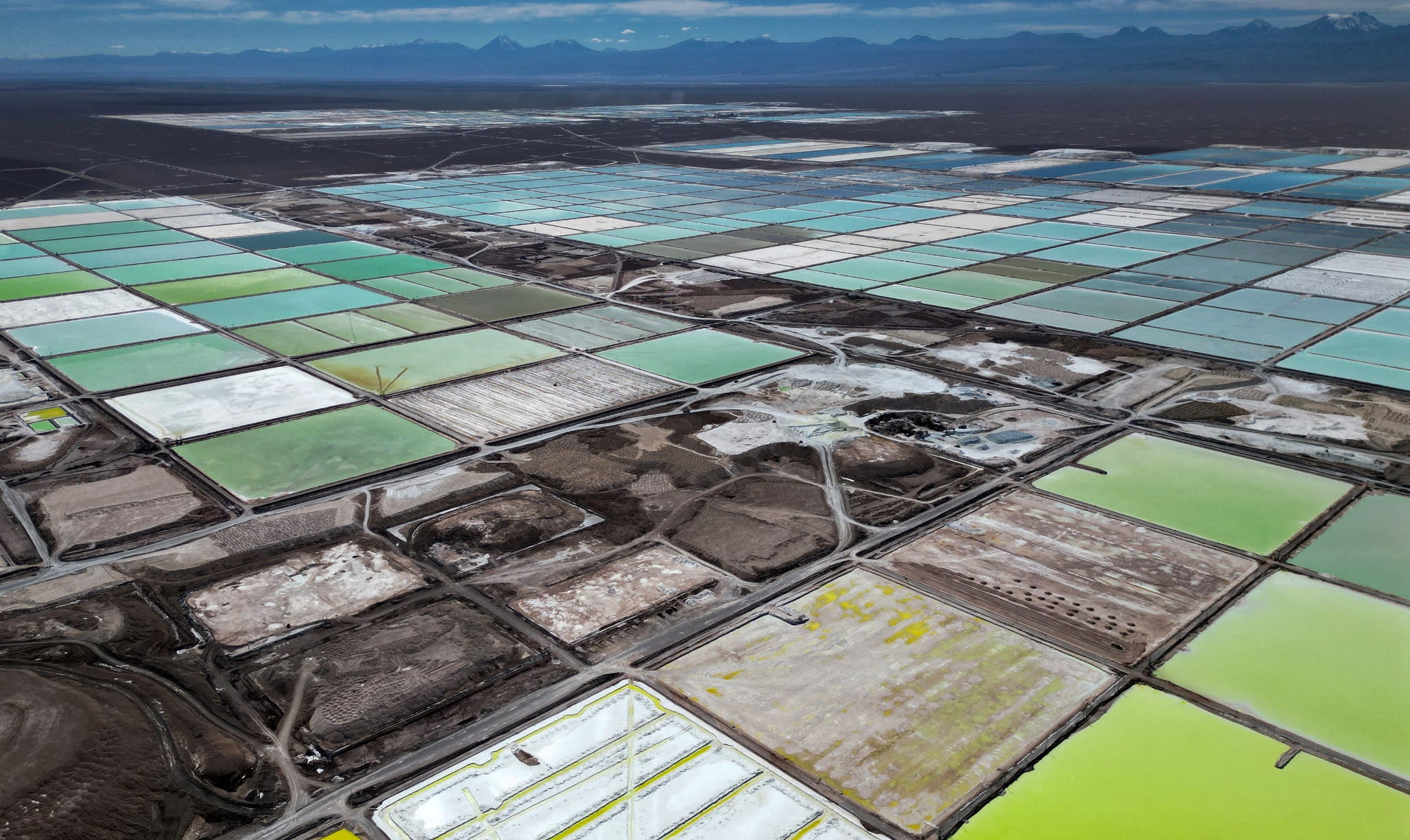
In April 2023, President Gabriel Boric made an announcement that Chilean presidents had been avoiding for decades. He decided to put the state in charge of the lithium industry, not to regulate it or collect taxes, but to directly participate in lithium production. This was a drastic change from the market-oriented orthodoxy that had defined Chilean resource policy since the 1990s. The lithium boom had rewritten the stakes. Global lithium prices had surged more than 400 percent between 2021 and 2022 as electric vehicle manufacturers became increasingly desperate to secure the limited supply. Chile, sitting atop 40 percent of the world’s known reserves, risked permanently having the opportunity flow entirely to private shareholders. Boric called his plan “an unprecedented milestone in Chilean mining.” But his strategy was the right call for the wrong institution: the partnership structure Boric implemented is sound, but handing its execution to a debt-ridden Codelco makes failure more likely than success.
Boric’s strategy, known as the National Lithium Strategy, is to work with a state-owned company called Codelco and a private company called Sociedad Química y Minera (SQM). Boric plans to create a company called Nova Andino Litio SpA, where Codelco will own 50 percent plus one share, which is a majority stake, while SQM will manage operations until 2030, at which point Codelco takes over. In return, SQM will get to keep its extraction rights until 2060. The state will get 70 percent of the profits from new production until 2030, rising to 85 percent after that.
Chile’s lithium matters to the world for one reason above all others: scale. The Atacama Salt Flat, where most of the country’s reserves sit, is one of the most mineral-dense brine deposits on the planet. Global lithium demand, driven primarily by EV batteries and grid storage, is projected to grow sixfold by 2030, from roughly 500,000 metric tons of lithium carbonate equivalent per year today to over three million. For Chile, this presents an opportunity and a challenge. Countries like Argentina are expanding production rapidly, and new African projects in Zimbabwe and the Democratic Republic of Congo are also attracting significant capital investments. Chile must capture value before it’s competed away.
The idea behind Boric’s plan is to offset the historical failures of full nationalization. For example, Bolivia holds the world’s largest known lithium reserves but produces almost none at commercial scale. This is a direct consequence of the country’s repeated nationalization attempt. Bolivia’s national policy drove out the technical expertise needed to develop the Salar de Uyuni, the largest salt flat in the world. Boric learned from this. SQM has the expertise that Chile needs, so rather than expropriating it, Boric decided to retain its operational knowledge while creating a strategic partnership to gradually transfer that expertise to Codelco. This way, the state will retain majority control while SQM privately manages the technical operations with a gradual handover to Codelco.
However, the problem is Codelco. The state copper company entered this partnership with $23.4 billion in net financial debt in 2025 and lost $591 million in 2023 alone. Its primary expansion projects, including the Chuquicamata underground conversion and the El Teniente New Mine Level project, have each run billions of dollars over budget and years behind schedule, largely because of the technical complexity of converting open-pit copper mines to underground operations. Each issue is further compounded by Coldelco’s aging infrastructure and slow bureaucratic procurement processes. The Chuquicamata conversion alone is now projected to cost over $5 billion, roughly double initial estimates. Its partner institution, ENAMI, has also been losing money since 2013, with total net losses surpassing $700 million. These losses are not the consequence of temporary setbacks from a bad commodity cycle but instead spring from fundamental structural issues, including old infrastructure and expensive long-term expansion projects. These expansions are approved by Codelco’s board, which includes government-appointed directors with incentives to prioritize protecting jobs and regional contracts over using capital efficiently. As a result, the main beneficiaries are often construction contractors, unionized workers with guaranteed employment, and government officials who can take credit for the investment without having the financial risk. On top of that, the company is legally required to transfer most of its profits directly to the Chilean government. It cannot sufficiently reinvest its earnings to build the operational capacity lithium will require.
The problem that plagues Boric’s strategy is that a state company that is focused on generating revenue for the government has fundamentally different incentives from a company focused on building a new industry. If Codelco’s lithium revenues are only used to cover its copper-division losses, which is something Chilean lawmakers have openly discussed, then the National Lithium Strategy will likely fail in achieving its goals.
Three rationales drove Boric’s decision to pursue state intervention. First, he wanted to capture a larger share of profits for the Chilean people rather than letting them go to foreign shareholders. Second, he wanted to use state ownership as a tool to steer the industry toward downstream processing, which is the process of turning raw lithium into battery-grade chemicals domestically rather than exporting unrefined ore. Third, and most urgently, he wanted to rebalance Chile’s exposure to Chinese capital. SQM’s second-largest stakeholder is Tianqi Lithium, a Chinese state-linked firm with a roughly 22 percent stake, and Western governments have been pressuring to reduce that dependency as part of broader critical minerals supply chain strategies. While Tianqi’s stake had given SQM access to Chinese capital markets and favourable procurement terms, Chile determined that the strategic value of having a lithium supply less dependent on China outweighed those benefits by giving Chile access to Western financing and greater flexibility to work with non-Chinese partners like American and European battery manufacturers. A fully private SQM, with its existing shareholder base, would have had far less flexibility to do the same.
Supporters of the deal, primarily Chilean government economists and center-left legislators who backed the deal, make two additional arguments in defense. First, SQM will still be in charge of operations until 2030, which will limit the immediate risk of Codelco’s inexperience disrupting production. Second, the partnership also includes plans to adopt direct lithium extraction (DLE) technologies that could reduce water consumption in the Atacama while improving yields. This is also seen as a meaningful concession to Indigenous communities and environmental advocates who have long opposed SQM’s water-intensive operations.
Nova Andino Litio held its first board meeting in December 2025, formally entering the implementation phase. The deal survived antitrust reviews in Chile and eight other countries, and passed a shareholder challenge by Tianqi in Chilean courts. Legal disputes have been ongoing since May 2024, and recently, Tianqi lost its final appeal against Chile’s state takeover of SQM. The structure has, for now, held. Boric’s developmental state model, where the government directs key industries to accelerate industrialization, as South Korea did with steel and semiconductors, or as Chile itself did with copper through Codelco’s early years. This model requires that the state entity be protected from short-term fiscal pressure and given the political cover to build capability before it is asked to deliver returns. South Korea’s POSCO steel plant was losing money for years before it became the world’s most efficient steelmaker. Early Codelco benefited from this. The Codelco of 2025 does not. It is debt-laden, politically exposed, and being handed a new commodity to manage at the exact moment when strategic stakes are highest and patience is shortest.
All in all, Chile’s partnership will almost certainly generate more revenue for the Chilean state than the prior structure they had in place. But the deeper ambition of building a Chilean lithium industry with domestic processing capacity and genuine technological advantage is unlikely to be achieved as long as Codelco remains the institution in control. What Chile needs is an institutional arrangement that matches its abundance in resources, and in that respect, Boric’s gamble remains unresolved. The most viable path forward would be to create a separate lithium agency, independent from Codelco, with its own budget and clear ten-year runway before it is expected to return a profit. Without it, any money lithium makes will keep getting pulled toward Codelco’s copper debts, and the bigger opportunity will slip away.

Victor Xu is a freshman at Columbia College studying Financial Economics and Computer Science. With a background in academic research, he is interested in exploring the role of emerging markets in the global clean energy transition.