


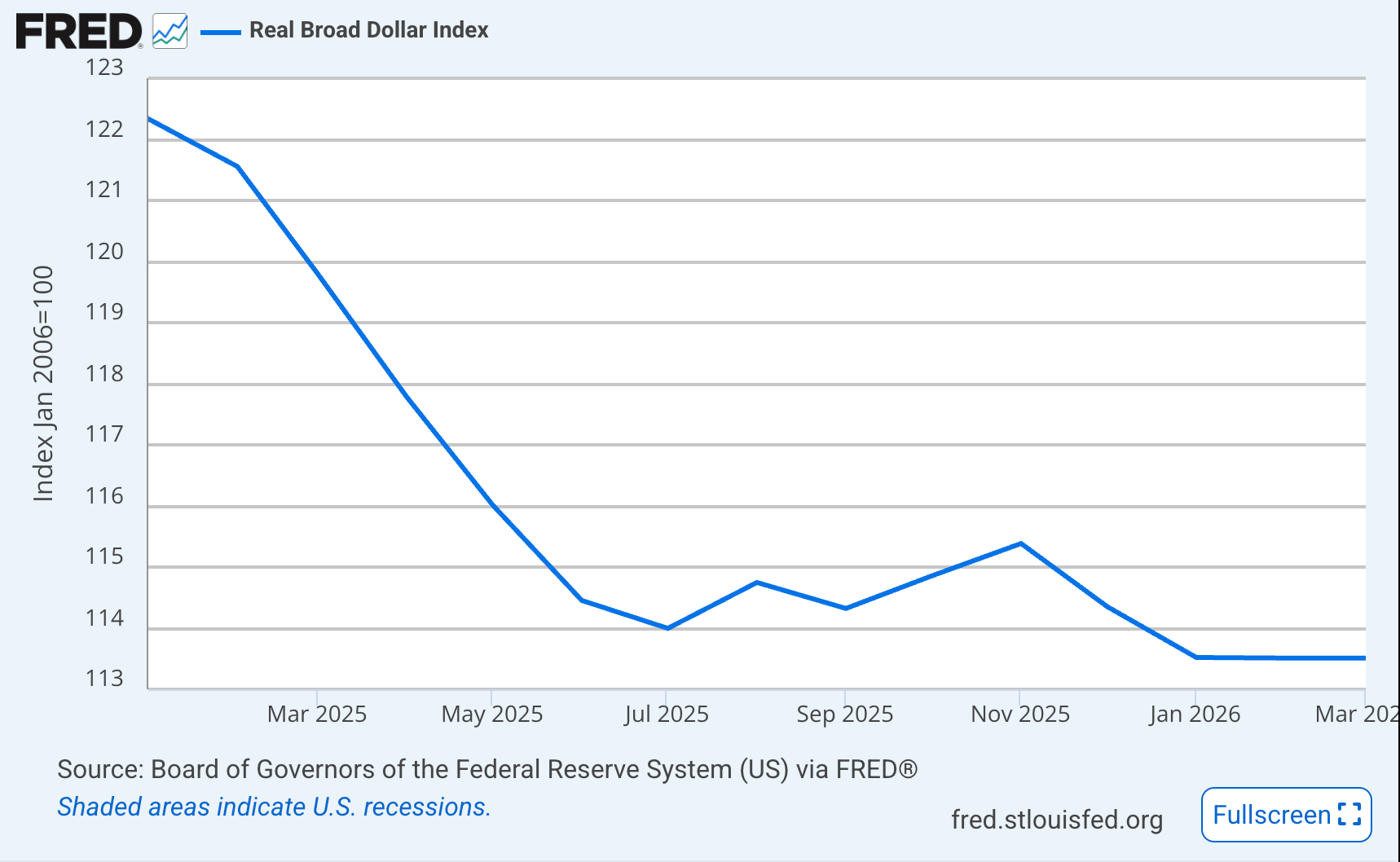
In March 2025, Türkiye offered a sharp test of conventional assumptions about emerging markets. The detention of Istanbul mayor Ekrem İmamoğlu triggered a market rupture that pushed the lira to a record intraday low, weakened local bonds and equities, and forced policymakers into emergency stabilization measures. The central bank reversed its easing cycle and raised the policy rate to 46 percent, as political instability translated directly into currency pressure and inflation risk. This episode unfolded during a broader period of dollar weakness, a context in which many investors anticipated improving conditions across emerging markets. The contrast highlights a more nuanced reality: although a weaker dollar can support emerging economies, its effects are neither automatic nor uniformly distributed. Its impact depends on domestic structures that determine whether global financial relief can translate into sustained local stability.
The conventional macro-financial framework is well established. A softer dollar reduces the local-currency burden of servicing dollar-denominated liabilities, eases global financial conditions, and tends to support capital inflows into emerging-market assets. Institutions such as the Bank for International Settlements emphasize these financial-channel effects, while market commentary has similarly noted investor diversification toward developing markets during periods of dollar depreciation. This framework captures the external impulse effectively. However, it does not fully explain the variation in outcomes across countries. The key distinction lies not in the presence of the external tailwind, but in the domestic capacity to absorb and transmit it.
Türkiye illustrates the limitations of this transmission. By early 2026, macroeconomic indicators suggested partial progress. Inflation declined from 49.4 percent in September 2024 to 30.9 percent in December 2025, while GDP growth remained relatively resilient. Yet these improvements did not resolve underlying vulnerabilities. Structural dependence on imported energy and intermediate goods continued to sustain a current-account deficit, while external debt remained substantial, with a significant portion concentrated in short-term obligations. This composition maintains elevated rollover risk and exposes the economy to shifts in investor sentiment. As a result, even within a favorable external environment, the domestic balance sheet constrains the extent to which global relief can translate into durable stability.
One critical mechanism shaping this outcome is the structure of external liabilities. In principle, a weaker dollar should reduce the burden of foreign-currency debt. In practice, the benefit is limited when refinancing needs are large and confidence remains fragile. The March 2025 shock disrupted reserve positions and weakened an already delicate disinflation process. Even as growth projections stabilized, persistent political uncertainty and reliance on short-term external funding continued to weigh on financial conditions. Under such circumstances, improvements in global liquidity do not eliminate refinancing risk; they merely moderate it.
The second constraint is exchange-rate pass-through. For a country to benefit cleanly from dollar weakness, exchange-rate movements have to translate into easier domestic price conditions rather than into renewed inflation instability. Türkiye does not meet that condition. After the March 2025 market shock, Reuters reported that officials were working with an estimated 40 percent exchange-rate pass-through assumption when assessing the inflation effects of the lira move. Pass-through changes the meaning of currency relief, and in a low-pass-through economy, exchange-rate appreciation can help anchor prices and loosen real financial conditions. In a high-pass-through economy, depreciation quickly reappears as higher inflation, which weakens the exchange rate’s stabilizing role. An IMF working paper published in 2026 argues that exchange-rate volatility has been central to Türkiye’s inflation process, even as services inflation remains more inertial than goods inflation. A recent NBER working paper makes the broader point even more sharply: Türkiye’s inflation and exchange-rate dynamics since 2021 are best understood not as a simple external shock story but as the result of weak monetary policy and impaired credibility. That is why the weaker-dollar thesis is too shallow on its own. It treats the exchange rate as a transmission channel; in Türkiye, the exchange rate is also a source of macro instability.
The third constraint is credibility, and this is where the Turkish case becomes decisive. A weaker dollar can buy time. It cannot substitute for a trusted nominal anchor. The IMF’s 2025 Article IV makes this explicit: to strengthen transmission and bolster policy credibility, directors called for a simpler monetary framework centered on the policy rate, enhanced communication, and stronger central-bank independence. Reuters’ earlier reporting on Turkish monetary policy documented repeated central-bank leadership turnover under President Erdoğan, a history that continues to shape how markets interpret every policy move. Credibility therefore does not enter this story as a vague institutional preference. It determines whether lower external pressure actually becomes lower inflation expectations, lower term premia, and more stable portfolio flows. Without credibility, the external tailwind remains reversible. With credibility, it becomes cumulative.
This is why Türkiye should not be treated as a counterexample that disproves the weaker-dollar trade. It is better understood as a case that clarifies its limits. At the aggregate emerging-markets level, the logic still holds: BIS research and Reuters’ market reporting both show that dollar weakness can improve financial conditions and revive demand for emerging-market assets. But the Turkish case shows that the magnitude of that benefit depends on the domestic political economy. Where external debt is short-term, pass-through is high, and monetary credibility is still being rebuilt, dollar weakness produces only partial relief. In this context, a weaker dollar functions less as a universal solution and more as an opportunity whose benefits depend on underlying resilience. Where financial structures are stable and policy frameworks are credible, external relief can reinforce positive dynamics. Where vulnerabilities persist, the same relief may remain partial and short-lived. Türkiye’s experience underscores the importance of these distinctions, illustrating that global tailwinds alone are insufficient to ensure sustained economic stability.

Hi, my name is Dylan Wang, class of 2029. I’m planning on majoring in Operations Research with a concentration on Financial Engineering, and I’m interested in wealth management, information technology, and the private credit industry. Outside of academics, I love to rock climb, creative write, do content creation, and play basketball.