



Image Source: Robert Nickelsberg/Getty Image
The global supply chain is a complex chain of relationships and transactions that fuel our day-to-day lives and underpin our modern economy. Despite the significant importance of the global supply chain, it still faces persistent disruptions and incidents that go beyond isolated events. Emerging markets such as the Dominican Republic (DR) are increasingly susceptible to supply chain volatility and should consider implementing AI-centered management systems.
For any given product, there are tens, if not hundreds, of parts transported across borders before being manufactured and ultimately delivered to consumers. Nearly every good and service is influenced by international trade relationships and geopolitics. Oftentimes, at the root of these disruptions are geopolitical tensions, where countries are at odds with one another, leading to trade restrictions through sanctions and tariffs. Unstable supply chain behaviour is particularly adverse for smaller countries that already face political instability and economic volatility.
The DR is a Caribbean island, well known for its beautiful beaches, resorts, and Latin culture. Tourism is a major driver for the country’s economy, accounting for 16 percent of the nation’s GDP and contributing to more than 800,000 jobs. The tourism industry relies on a steady flow of imported goods to accommodate guests and provide them with a memorable experience. Furthermore, supply chain disruptions impact more than just singular industries; they affect the broader flow of products entering and leaving the countries.
Following the COVID-19 pandemic, the DR’s path forward seemed uncertain amid the global halt to travel and production, exacerbated by pre-existing staff shortages: 72% of surveyed companies reported that the COVID-19 pandemic had a negative impact on their operations. The DR faced a 6.7% decline in GDP compared to the year prior to COVID-19. This came as a major blowback to the island’s development in light of its progress in preventing poverty. Leading up to the pandemic, the poverty rate in the country had nearly halved.
Following the pandemic, many management teams shifted towards automating supply chain positions as a solution to the staff-related shortages. Of the surveyed companies, 63% indicated increased automation and investments in AI and machine learning. This represents a shift in how large corporations approach supply chain management, favoring a more comprehensive, data-driven approach over a traditionally large and complex supply chain system.
As a result, this wave of automation had created an equity gap. As major corporations invest heavily in AI and machine learning infrastructure, smaller countries and emerging markets are at risk of developing dependence on developed economies for advanced technology. Data suggest that the AI readiness of a country is correlated with its industrial development status. Therefore, developed economies are more likely to implement AI-focused management systems in comparison to developing economies such as the DR.
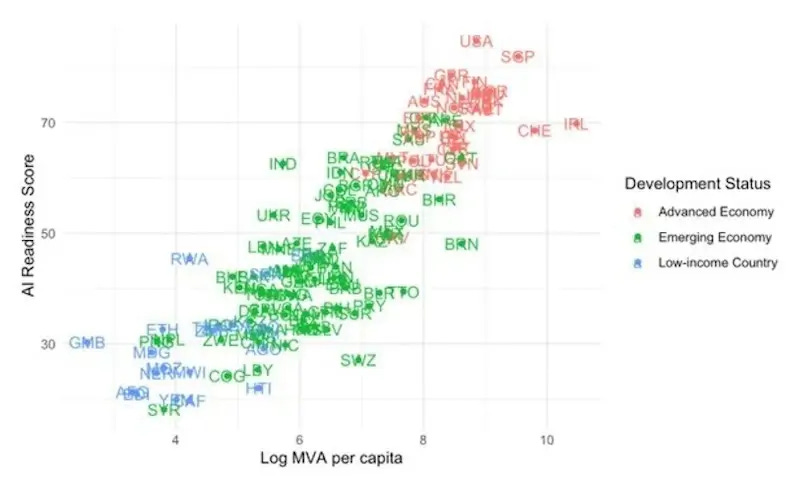
In light of these barriers, countries like the DR should prioritize investments in data analysis and management systems guided by AI and new technologies. Such systems, if tailored for a country’s specific needs, could help prepare for and mitigate supply chain bottlenecks and disruptions before they occur. Realistic AI deployment due to the high cost of starting and maintaining it should zoom in on sector-specific needs and present scalable approaches suited for the country’s particular vulnerabilities.
In comparison, Singapore, an emerging market and a smaller island nation similar to the DR, has already begun AI implementation into its supply chain systems. For example, Singapore implemented an AI risk assessment system created by the Transport Asset Protection Association (TAPA), which mined crime data and security ratings of facilities to predict the potential risk associated with a transportation route. In cases where a route was deemed high-risk, the TAPA system provided alternative routes with lower risk.
For the DR, the precedent that Singapore has set presents an opportunity to support a government-backed data collection process that compiles import/export data and employs AI systems, such as those TAPA offers, to create a preventive system for unforeseen disruptions. This way, smaller businesses aren’t required to build independent systems, reducing the fiscal barrier to AI deployment and overall making automation a more equitable application for various sectors in the country.
Furthermore, to reduce the cost associated with reliance on external companies offering AI deployment tools, it is essential to train data analysts and supply chain experts to locally maintain AI systems and eliminate the reliance on more developed countries. This ensures that solutions and changes are made with the country’s evolving needs in mind, rather than profit-driven approaches that prioritize a company’s revenue statement.
As technology and our global economy continue to develop, they are more intertwined and reliant on each other than ever before. In the race to automate systems to approach modern problems with modern solutions, developing economies should consider implementing small-scale applications to stay competitive and engaged in global market changes.

Rabira Dosho is a freshman studying finance and political science with an interest in supply chain efficiency and geopolitics. In his free time, he enjoys working out, cooking, and meeting new people.